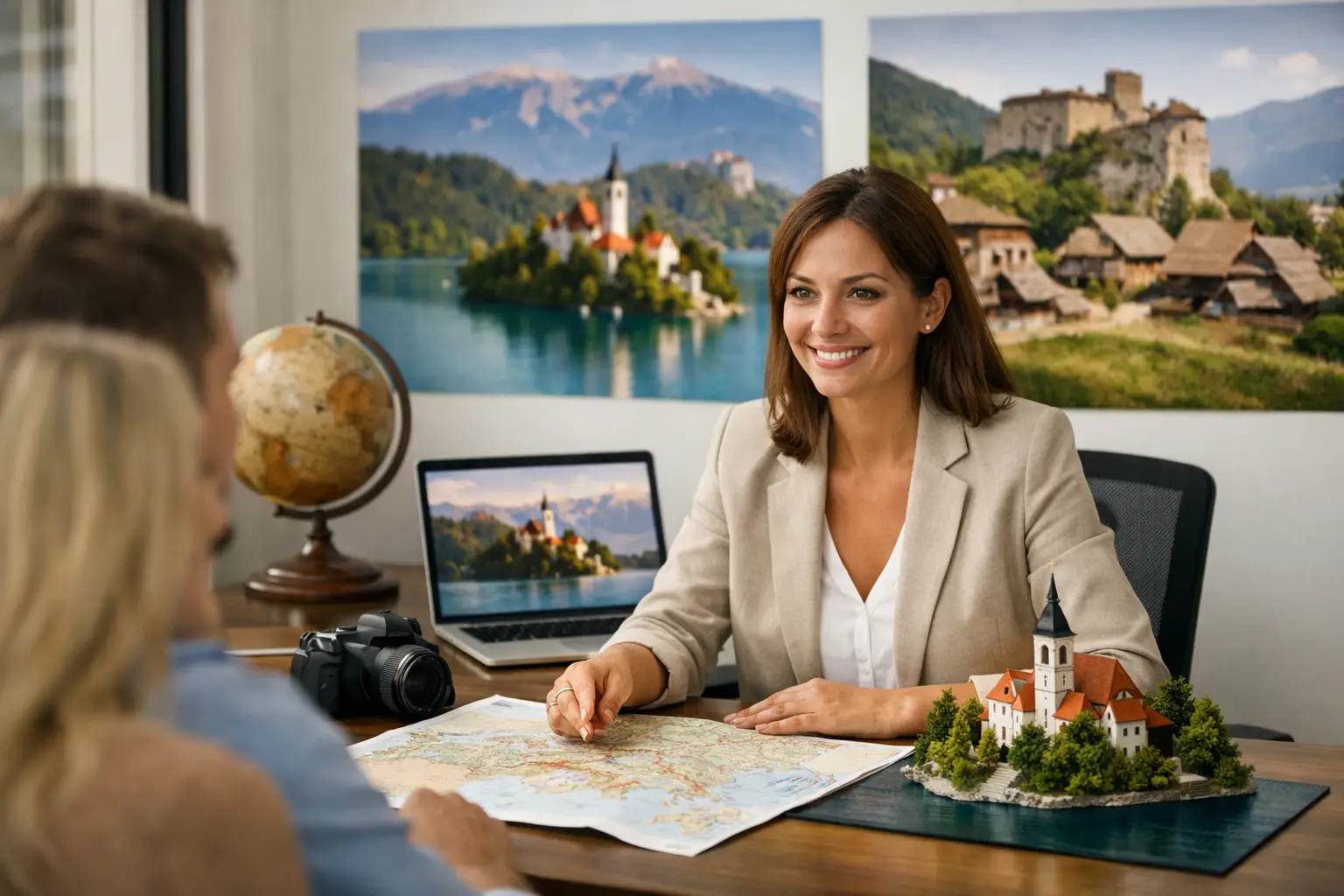


You may have a surname, a faded baptism record, or a story about a grandfather who left “a village near Ljubljana.” What you often do not have is the missing bridge between family memory and a real place you can stand in. That is where a Slovenia heritage travel expert becomes invaluable – not as a tour guide for landmarks, but as a trusted partner in returning your family story to the landscape where it began.
For many people of Slovenian descent in the United States, Canada, Argentina, or Australia, the desire to visit Slovenia is not really about checking a country off a list. It is about recognition. You want to know which church your ancestors attended, which hillside farm they worked, which cemetery still holds your family name, and whether the stories passed down at the dinner table match the historical record. Heritage travel asks different questions than ordinary tourism, and it deserves a different kind of expertise.
What a Slovenia heritage travel expert actually does
A true heritage specialist works at the intersection of genealogy, local history, and in-country travel planning. That matters because ancestral journeys are rarely straightforward. A family may have used a Germanized surname in one record, a Slovenian version in another, and an Americanized spelling after immigration. A village name might have changed over time, or a border may have shifted. Parish boundaries may not match modern municipalities. Without local knowledge, even motivated researchers can spend years following the wrong trail.
A Slovenia heritage travel expert helps organize that uncertainty into a practical path forward. The work often starts long before a flight is booked. Family documents, immigration papers, obituaries, old letters, naturalization records, and oral history are reviewed for clues. Those clues are then compared with Slovenian geography, naming patterns, church records, and archival sources to identify likely places of origin.
This is the difference between visiting Slovenia and returning to your family homeland with purpose. Instead of a broad itinerary built around famous sights, the journey becomes rooted in evidence, context, and emotional meaning.
Why heritage travel in Slovenia is different from regular travel
Slovenia is small, but family history here can be surprisingly complex. Regions such as Gorenjska, Styria, Primorska, Dolenjska, and Prekmurje each carry distinct historical influences, dialects, and record traditions. An ancestor may have identified with a parish, a village, an empire, or a departure port rather than the modern nation-state travelers know today.
That complexity can be deeply rewarding when handled well. A visit to an ancestral village is not just scenic. It can answer personal questions that documents alone cannot. You notice the steep roads your great-grandparents walked, the distance between the church and the family home, the terrain that shaped daily life, and the local customs that traveled with emigrants abroad. Suddenly, family history stops feeling abstract.
At the same time, there are trade-offs. Not every journey leads to a dramatic discovery. Some records are missing. Some homes no longer stand. Some villages were absorbed into larger municipalities, and some surnames that once seemed unique turn out to be widely shared. The value of expert guidance is not that it guarantees a perfect ending. It is that it helps you ask better questions, interpret evidence carefully, and build a journey around what can truly be known.
The research comes first – and that is a gift
Many travelers understandably want to start with the itinerary. They picture Lake Bled, Ljubljana, or the Julian Alps and wonder how to fit family history around those stops. But for ancestry-based travel, research should lead and travel should follow.
That order is not restrictive. It is actually liberating. When the foundational work is done first, the trip becomes more personal and less vague. You are not simply spending a day in “the countryside.” You are visiting the exact parish where your great-grandparents married. You are not stopping by a cemetery at random. You are standing at a grave that may connect generations of your family line.
This is where a specialized business such as Ancestry Slovenia offers something meaningful. The process is designed to connect paper records with physical places, so that the journey reflects your family rather than a generic route through the country.
What to expect from a guided ancestry journey
Every family starts from a different point. Some people arrive with little more than a surname and a rumor. Others already have ship manifests, census records, and family trees but need help interpreting them in a Slovenian context. A good heritage travel process meets both kinds of travelers where they are.
The first stage is usually discovery. Existing records are gathered, names are reviewed for spelling variations, and likely regions of origin are assessed. Sometimes a single clue – a parish name on a marriage record or a sponsor listed on a baptismal certificate – changes the whole direction of research.
The next stage is place identification. This is often the most emotional moment, because a village that existed only in family stories becomes real. It appears on a map. It can be visited. It has a church, neighboring settlements, local archives, and historical context.
Only then does itinerary planning make full sense. Travel can be built around the places that matter most: an ancestral village, a parish church, a local archive, a cemetery, or even a family farm site if the location can be confirmed. There may still be room for broader sightseeing, of course, but the heart of the trip is no longer generic tourism. It is family reconnection.
A Slovenia heritage travel expert helps with more than records
Research is essential, but emotional guidance matters too. Heritage travel can stir up more than curiosity. It may bring pride, grief, relief, or a strange sense of familiarity in a place you have never been. For descendants of emigrants, there is often a quiet question beneath the logistics: Will this place feel like mine in any way?
No expert can answer that in advance. But the right one can create the conditions for a meaningful encounter. That includes pacing the trip thoughtfully, providing historical context, preparing you for what may or may not be found, and helping you understand local customs so the experience feels respectful rather than extractive.
This matters especially when visiting churches, archives, and villages where family ties are personal, not performative. Heritage travel is not about claiming a dramatic identity after one visit. It is about listening carefully to the evidence, honoring the people who came before you, and allowing place to deepen your understanding.
How to know if you need a Slovenia heritage travel expert
If your ancestry clues are scattered, your place names are uncertain, or your records do not quite line up, expert help can save enormous time and disappointment. The same is true if you already know the village but want to turn that knowledge into a trip that feels grounded, respectful, and worthwhile.
You may also benefit from expert support if you are traveling with family members across generations. A heritage journey often carries different meanings for each person. One wants archives, another wants stories, another simply wants to see where the family began. A well-planned ancestry trip can hold all of those needs together.
And sometimes the simplest reason is the most honest one: this matters too much to leave to guesswork. When a trip may happen only once, it makes sense to build it on more than hope.
The real value of coming home with context
People often imagine that the most important moment will be arriving in the ancestral village. Sometimes it is. But just as often, the lasting impact comes later, when you return home with a fuller understanding of your family’s story. The places you visited begin to change the way you read old documents, tell family stories, and pass history to children and grandchildren.
A name on a passenger list becomes a person who left a specific valley. A family recipe carries the flavor of a region. A church record is no longer just handwriting on a page, but part of a community you have seen with your own eyes.
That is the quiet work of heritage travel at its best. A Slovenia heritage travel expert does not simply arrange a visit. They help transform inherited fragments into connection, and connection into memory you can carry forward. If your family story has been waiting in records, photographs, and half-remembered names, there is something deeply hopeful in knowing it can still lead you home.