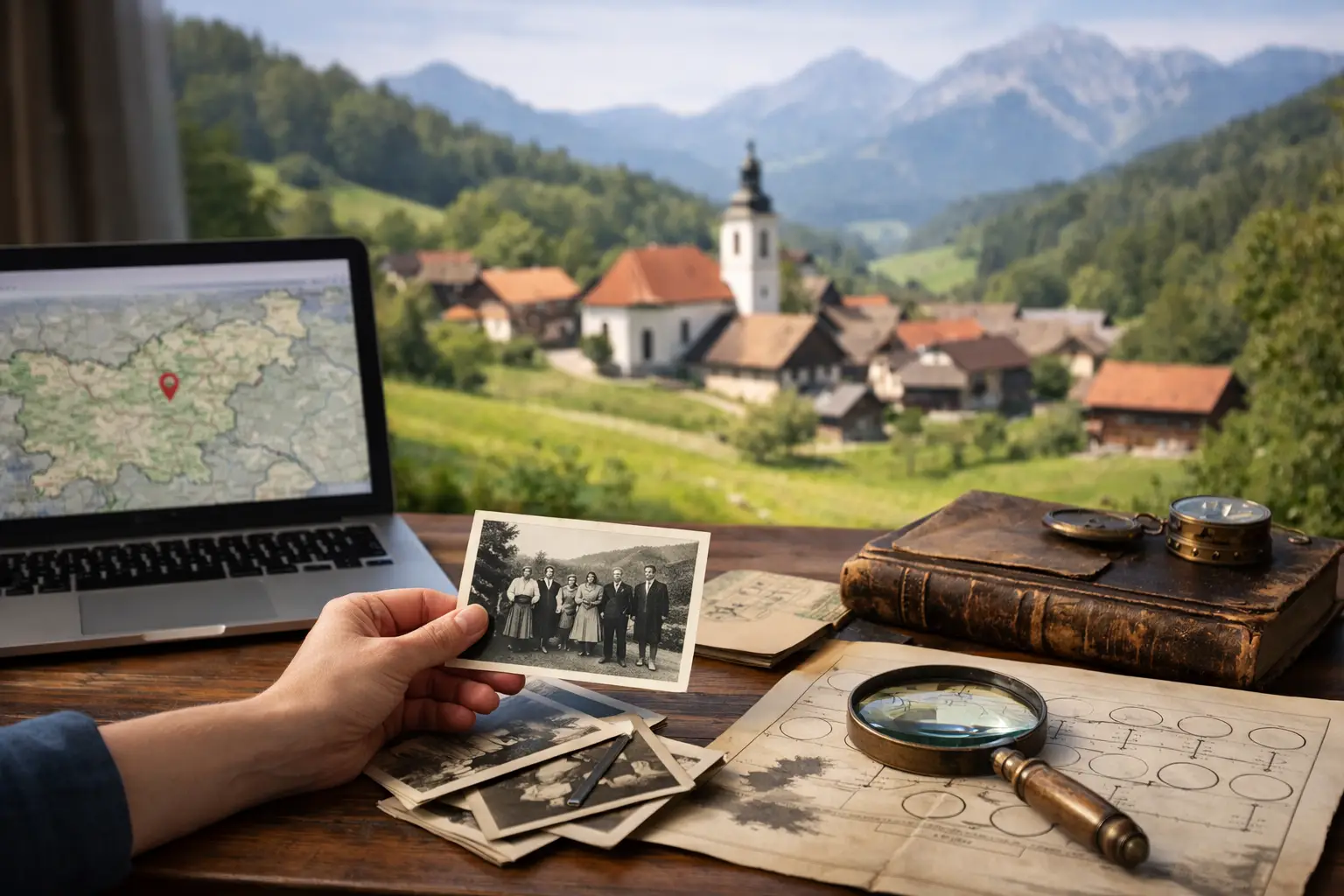


A name on a ship manifest can stir something deep, but it rarely tells you enough. A successful slovenian ancestral village search begins when a family story, an old record, or a remembered surname starts pointing toward one real place – not just Slovenia in general, but a specific village where your family lived, married, worked, and worshipped.
For many descendants of Slovenian emigrants, that search is both practical and emotional. You may have heard that your grandfather came from “near Ljubljana” or that your great-grandmother was “from the old country,” but those descriptions are often too broad to lead anywhere meaningful. Finding the ancestral village is what turns heritage from a general identity into a place-based story you can actually follow.
Why a slovenian ancestral village search matters
Slovenia is small, but family research there is rarely simple. Borders shifted, place names changed, records were kept in different languages, and one surname can appear in several regions. If you search too broadly, you can spend months following the wrong family line.
The village matters because records were local. Parish registers, civil records, land records, and cemetery information are usually tied to a specific parish or municipality. Once the village is correctly identified, your research often becomes far more precise. You can move from guessing to verifying.
It also matters for a different reason – the human one. Returning to the right village is not the same as taking a general heritage trip. Standing in the church where your ancestors were baptized, walking the road they likely knew, or seeing the hills they left behind gives family history a weight that documents alone cannot provide.
What most people start with
Very few people begin with a complete paper trail. More often, they begin with fragments. An old family letter, a naturalization file, a funeral card, a church record in the United States, or a surname that has been passed down for generations may be all you have.
That is more useful than it sounds.
Even partial clues can narrow a search if they are handled carefully. A US death certificate might list a town name that was spelled phonetically. A marriage record may name a province, parish, or village in an older form. A passenger list may reference the nearest larger town rather than the actual birthplace. In Slovenian research, these small distinctions matter.
The goal at this stage is not to force a quick answer. It is to gather every clue and let the evidence build toward one likely place. Sometimes the answer appears quickly. Sometimes the search takes patience, especially if your ancestors emigrated under Austria-Hungary, identified with a historical region, or came from an area where multiple languages shaped the records.
The records that often reveal the village
A strong slovenian ancestral village search usually depends on records created outside Slovenia before it depends on records inside Slovenia. That surprises many families, but it makes sense. Immigrants often named their birthplace in documents created after arrival, especially in church and naturalization records.
US and overseas records worth reviewing include passenger manifests, naturalization petitions, obituaries, marriage licenses, death certificates, church sacramental records, military registrations, and gravestones. Family Bibles, photographs, and handwritten notes can also contain crucial place clues. Sometimes the village is hiding in plain sight on a document that has been in the family for years.
Once a likely location emerges, Slovenian parish and civil records become much more useful. At that point, it may be possible to confirm births, marriages, family relationships, house numbers, and burial places. If the village is still uncertain, local knowledge becomes especially important because spelling variations and historical geography can easily mislead a researcher who is unfamiliar with Slovenia.
Why village names are often harder than they seem
One of the most common frustrations in a Slovenian ancestral village search is realizing that the place name you were given does not appear on a modern map. That does not always mean the family story was wrong. It may mean the name was recorded in German, Italian, Hungarian, or an older local form. It may also refer to a hamlet, parish, or district rather than an independent village.
There is also the problem of duplicate names. Some village names appear in more than one part of Slovenia. Without the right parish, county, or family context, it is easy to attach your ancestors to the wrong place.
This is where genealogy becomes more than record collection. It requires interpretation. You have to compare dates, migration patterns, naming traditions, religion, nearby towns, and family associations. The right answer is usually built from several clues working together, not one dramatic discovery.
From records to real places
Once the ancestral village is identified with confidence, the search changes character. It is no longer only about proving where a person came from. It becomes an opportunity to understand how they lived.
A village-centered ancestry journey can reveal the parish church, cemetery, original house area, surrounding farms, local archives, and nearby market towns that shaped everyday life. You begin to see what departure may have meant. Was your family from a mountain village, a wine region, an industrial area, or a farming community? Did they leave for economic reasons, family connections abroad, or political change? Place helps answer those questions in a way names and dates cannot.
For many descendants, this is the moment when family history stops feeling distant. It becomes physical. You can hear the church bells, notice the terrain, and understand how close one village was to the next. Even a short visit can bring clarity to stories that have been abstract for generations.
When to get expert help
Some searches are straightforward, especially when you already have a precise town name and a strong paper trail. Others are not. If your records conflict, your surname is common, or the place name appears in multiple forms, professional guidance can save a great deal of time and disappointment.
This is particularly true if your goal is not only research, but travel. Planning a heritage journey before the village is properly identified can lead to a moving trip, but not necessarily the right one. The most meaningful ancestry travel usually begins with evidence first, then builds the visit around confirmed places and family connections where possible.
That is the value of a heritage-centered approach. At Ancestry Slovenia, the work is not just about locating a place on a map. It is about connecting records, local knowledge, and travel planning so that descendants can return to their roots with confidence and context.
What to gather before you begin
If you are preparing for your own search, start by collecting the documents and memories already within reach. Ask relatives for original names, nicknames, dates, religious affiliation, immigration timing, and any remembered village pronunciation. Save copies of certificates, letters, memorial cards, and old photographs, even if they seem unrelated.
Try to preserve the exact wording from records rather than modernizing it too quickly. A misspelled place name may still contain the clue you need. It also helps to track witnesses, godparents, and neighbors in immigrant records. Families often migrated with people from the same village, and those associated names can point back to the correct location.
Most of all, be open to revision. The first village candidate is not always the right one. Good research is careful, not rushed.
More than a search
A slovenian ancestral village search is rarely only about geography. It is about recovering a point of origin that gives shape to your family story. For some people, that means finally confirming what their grandparents always said. For others, it means correcting a long-held assumption and finding a truer path back.
Either way, the result can be deeply grounding. When you know the village, you are no longer looking at Slovenia as a distant homeland in the abstract. You are looking at your family’s Slovenia – the place where their story began before it continued in America, Canada, Australia, Argentina, or elsewhere.
If you are holding only fragments, that is enough to begin. Family history often returns in pieces before it returns as a whole, and sometimes one village name is the piece that changes everything.