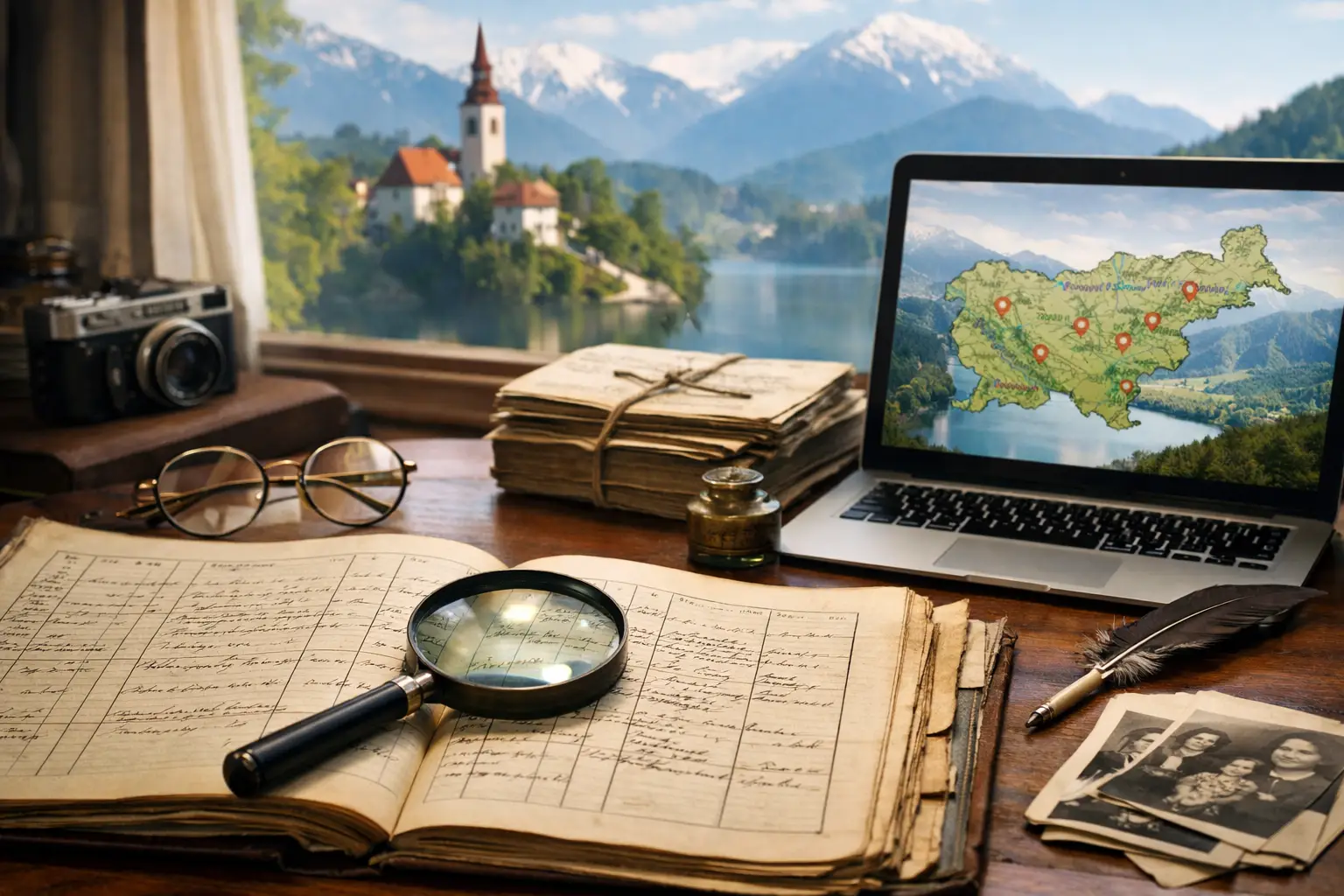
A surname scribbled on the back of an old photo, a baptismal medal in a drawer, a family story about “the old country” – this is often where a Slovenian church records search begins. For many descendants abroad, parish records are the first place where family history stops being vague and starts becoming local, personal, and real.
Why a Slovenian church records search matters
In Slovenian family research, church records are often the bridge between memory and place. Civil registration did not develop in the same way or at the same time across all historical regions, and many of the most useful early records were kept by Catholic parishes. Depending on the area and period, Lutheran and other church communities may also be relevant, but parish books remain central for a large share of Slovenian ancestry.
These records can do more than confirm a date. A baptism may name a village, house number, godparents, and the mother under her maiden name. A marriage entry may point to two different parishes and connect families across neighboring communities. A burial record can help explain why a child disappears from later family stories or why a widow appears in a new household. Small details like these often become the clues that lead to an ancestral village.
That is why church research can feel so moving. You are not just finding names. You are locating the church where your great-grandparents stood, the parish community that marked their life’s milestones, and the landscape that shaped their world.
What Slovenian church records usually include
Most people begin with baptisms, marriages, and burials, and for good reason. These are the core records that can anchor a family line. In many Slovenian parish books, baptism records provide the richest information, especially if the priest was careful and the handwriting is legible. You may find a birth date, baptism date, parents’ names, residence, legitimacy status, and sponsors.
Marriage records are especially valuable when you are trying to move from one generation to the next. They often include the bride and groom’s ages, marital status, places of origin, and sometimes the names of their fathers. If your ancestors emigrated after marriage, this record can be the key to placing the family in the correct parish before departure.
Burial records tend to be less detailed, but they still matter. They can help distinguish between people with the same name and fill in family tragedies that never made it into oral history. In some cases, confirmation lists, status animarum, or parish family books also survive. These can function almost like an early census, showing entire households over time.
How to begin a Slovenian church records search with limited information
Many descendants start with far less than they wish they had. Maybe you know only that your grandfather was “from near Ljubljana” or that your family name sounded like Novak, Kovačič, or Zupančič before it was changed in America. That is normal.
The first step is to work backward from the most recent confirmed facts. Gather death certificates, obituaries, naturalization files, cemetery records, passenger lists, old passports, family prayer cards, and marriage certificates from the country where your ancestors settled. The goal is not to collect everything. The goal is to identify one reliable place-name, parish name, or original spelling.
This matters because Slovenia’s historical geography can be tricky. Your ancestors may have identified with a village, a parish, a district, a crown land, or the Austro-Hungarian Empire depending on the year and the record. Some families said they were “Austrian” or “Yugoslav” when they were in fact from what is now Slovenia. A church search works best when you can narrow the location as precisely as possible.
Finding the right parish is often the real breakthrough
A common misconception is that research begins by searching a name in a big index. Sometimes indexes exist, but often the real work is geographic. You need to know which parish served the village where the family lived.
That can be harder than it sounds. A small settlement may never have had its own parish and may have belonged to a neighboring one. Boundaries changed. Villages with similar names exist in different regions. Older records may use German, Latin, or older Slovene spellings. A place remembered in family stories may be a hamlet rather than a formal town.
Once the correct parish is identified, the search becomes much more focused. Instead of scanning all of Slovenia, you are working within the community that recorded your family’s sacraments. This is often where uncertainty gives way to confidence.
Language, handwriting, and historical detail
One reason Slovenian parish records can feel intimidating is that they rarely match modern expectations. Entries may be written in Latin, German, or Slovene, sometimes with more than one language appearing in the same register. Names may shift from one version to another. Johannes might be Janez, Franz could be Franc, and a surname may appear in several spellings even within one family.
Handwriting adds another layer. Nineteenth-century script can be difficult even for experienced researchers, especially when the priest wrote quickly or the page has faded. Dates may be clear while place-names are not. Occupations and relationship notes may be abbreviated. The good news is that records usually become easier once you learn the patterns of a specific parish book.
This is where patience matters. A single entry taken alone can be misleading. Several entries from the same family, compared across baptisms, marriages, and burials, usually tell a clearer story.
Common challenges in Slovenian church records search
The most frustrating search is often not the impossible one, but the almost-right one. You find the correct surname in the wrong parish. You find the right village but the dates are off by five years. You find two men with the same name marrying within a decade of each other. These situations are common in Slovenian genealogy.
It also depends on the region. Some parish records are well preserved and easier to access. Others may have gaps, damage, or access limitations. In border areas, historical identity can be especially layered, and records may point toward archives or church jurisdictions outside present-day assumptions.
Another challenge is assuming the first match is the right ancestor. When families reused given names across generations, it is easy to attach yourself to a record that feels promising but belongs to someone else. The safer approach is to build proof through clusters of evidence – parents, sponsors, spouses, house numbers, and neighboring families.
When records become more than documents
For descendants living far from Slovenia, parish entries often create the first real sense of return. An old baptism line can reveal not just who an ancestor was, but where they belonged. Suddenly a village is not an abstract dot on a map. It is the place where your family brought children to the font, buried loved ones, and marked Sundays and feast days for generations.
This is why research and travel fit together so naturally. Once you know the parish, you may be able to stand in front of the same church, walk through the village lanes, and understand how near one hamlet was to another. Family history becomes easier to feel when geography is no longer theoretical.
That is also why local guidance can make such a difference. Research done from abroad often stalls at the exact moment when regional knowledge is most needed – to interpret a village name, distinguish similar parishes, or connect an archival clue to a real place in Slovenia. At Ancestry Slovenia, this kind of work is part of helping descendants move from records on a page to a meaningful journey home.
A practical way forward
If you are starting now, begin with what your family already has, even if it seems small. Write down every spelling variation, every village memory, every saint card, every marriage witness, every clue from an obituary. Then organize those facts by person and timeline. Patterns often appear where isolated details once seemed useless.
If you already have records but feel stuck, step back and ask whether you have identified the correct parish, not just the correct surname. In Slovenian genealogy, that question often changes everything.
And if the search has become emotional, let it. A Slovenian church records search is rarely just about documentation. It is about recovering a thread that migration stretched across oceans and generations. Sometimes the next record you find is not simply another entry in a register. Sometimes it is the first clear sign of where home began.