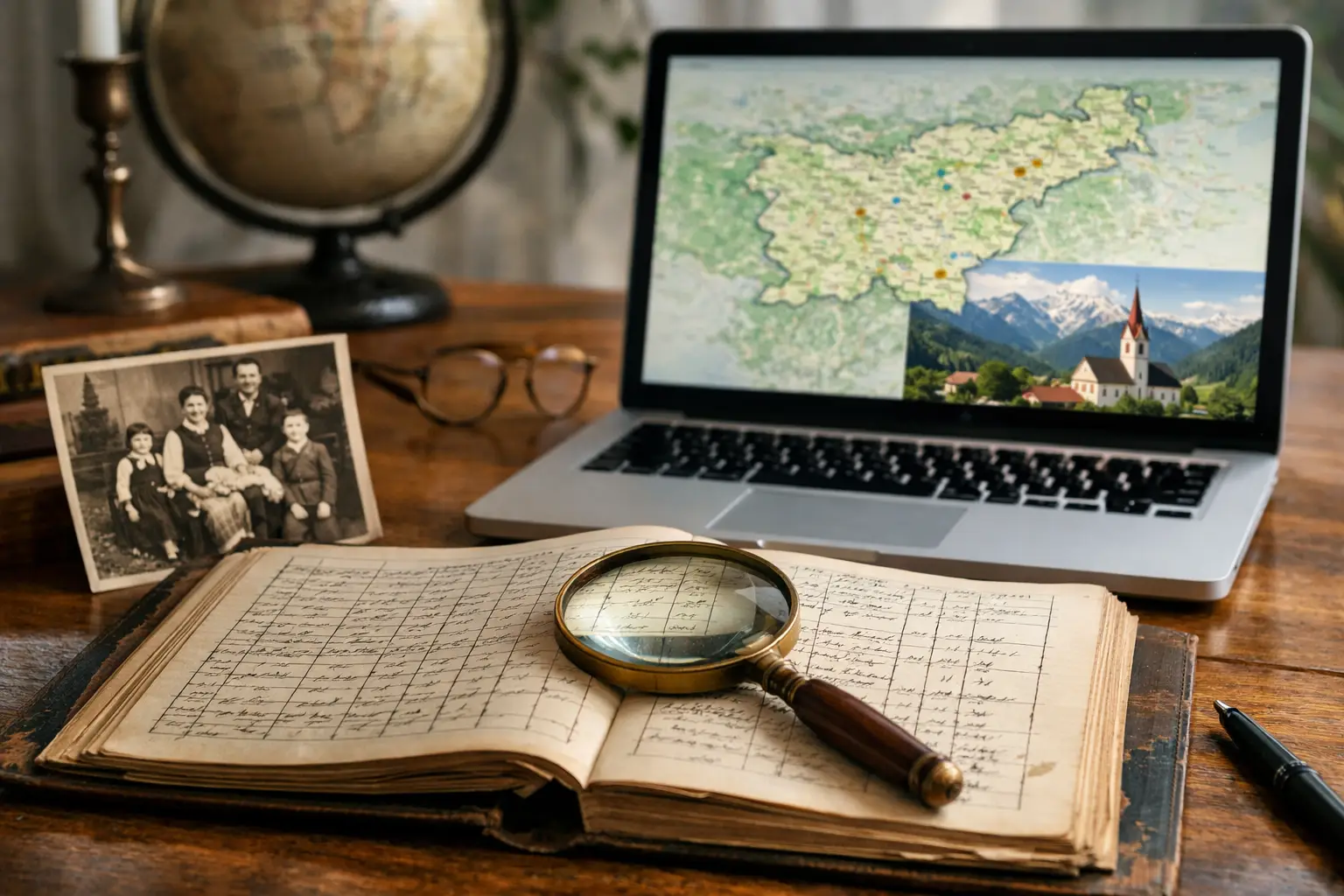
A slovenian parish records search often begins with one small clue – a surname on a gravestone, a place name half remembered, or a baptismal certificate tucked into a family Bible. For many Slovenian descendants abroad, that first clue carries more than curiosity. It carries the hope of finding the church where an ancestor was baptized, the village where generations lived, and the place where family history stopped being abstract and became real.
Parish records are often the bridge between family stories and documented proof. In Slovenian genealogy, they matter because civil registration came later in many areas, while parish books preserved baptisms, marriages, and burials for centuries. If your ancestors left what is now Slovenia in the late 19th or early 20th century, there is a good chance the most meaningful records of their early lives were created by a local Catholic parish.
Why a Slovenian parish records search matters so much
When descendants begin tracing family from the United States, Canada, Argentina, or Australia, they usually start with records created after immigration. Census entries, naturalization papers, obituaries, and death certificates can tell you where a person ended up. Parish records help tell you where that life began.
A baptism entry may name parents, godparents, a home village, and sometimes even a house number. A marriage record can connect two family lines and confirm whether a bride came from another parish. A burial entry may reveal age at death and help estimate a birth year when no other record survives. These are not just administrative details. They are often the first records that place your ancestor inside a real community.
That is why parish research can feel deeply personal. You are not simply finding a date. You are locating the church bell your family heard, the faith community they belonged to, and the parish landscape that shaped daily life.
What you may find in Slovenian parish records
Most people think of baptism, marriage, and burial books, and those are the foundation. But the value of a Slovenian parish records search depends on the parish, the time period, and the condition of the surviving books.
Baptism records may include the child’s name, date of birth and baptism, parents’ names, the mother’s maiden name, legitimacy status, sponsors, and residence. Marriage entries may list ages, birthplaces, parents, occupations, and whether the couple was from the same parish. Burial records often include age, marital status, cause of death in some periods, and burial date.
In some cases, later annotations appear in older baptism books. A priest might have added a note about marriage, migration, or death years later. Those small marginal notes can be surprisingly valuable, especially when a family crossed parish or national boundaries.
Still, it depends on the era. Earlier entries may be brief and written in Latin. Later records may appear in German or Slovene, depending on the period and local administration. Handwriting can be difficult, and place names may be recorded in historical forms rather than the names used today.
The hardest part of parish research is usually not the record
It is identifying the correct parish.
Many families come to Slovenian research with a country name but not a village. That is understandable. Ancestors often told American officials they were from Austria, Yugoslavia, or simply “Slovenia” long before modern borders made sense to later generations. Even when a place name survives in family memory, the spelling may have changed through immigration, translation, or pronunciation.
This is where parish research becomes both careful and detective-like. A single village might belong to one parish for baptisms, another for marriages, and yet another administrative district for civil records. Nearby branches of the same family may appear in different books. If your ancestor came from a small hamlet, the parish you need may not share the same name as the village.
That is why the strongest searches begin before anyone opens a parish register. You gather every clue from immigration records, draft cards, passenger lists, ethnic newspapers, cemetery records, and family documents. The goal is to narrow a person to a village or at least a small region. Once that happens, parish identification becomes much more accurate.
How to approach a Slovenian parish records search
Start with what your family knows, even if it seems incomplete. Old letters, prayer cards, funeral cards, church certificates, and photographs with inscriptions can all contain place clues. Ask older relatives not only for names, but for nicknames, house names, saints remembered in the family, and stories about nearby towns. Sometimes a remembered pilgrimage church or local feast day points toward a region.
Next, compare those family clues with records created in the country where your ancestor settled. American marriage records, death certificates, and obituaries often contain a birthplace, though the wording may be broad or misspelled. Naturalization files can be especially useful because they sometimes name a town of origin rather than just a country.
Once you have a likely village, the next step is to determine the historical parish serving that location during your ancestor’s lifetime. This matters because parish boundaries changed. A village that belongs to one parish today may have belonged to another one hundred years ago. Searching the wrong parish can waste hours and leave you thinking a family vanished when they are simply recorded elsewhere.
After the parish is identified, the record search itself becomes more targeted. You estimate a birth year, marriage window, or death period and search in the relevant sacramental books. If one record is found, it often unlocks the next. A baptism gives parents’ names. Their marriage record may reveal grandparents. Grandparents’ burial entries may help push the line back another generation.
What makes Slovenian records challenging
The records are rich, but they are not always easy.
Language is one challenge. Depending on the period, you may be working with Latin formulas, German headings, old Slovene terms, or a mix of all three. Handwriting presents another barrier, especially in 18th and 19th century registers. Surnames may shift in spelling from one entry to another. Women may appear under maiden names, married surnames, or Latinized versions.
Geography can complicate matters too. Slovenia is small, but local history is layered. Borders shifted. Administrative jurisdictions changed. Some parishes created duplicate books, while others suffered record loss or gaps. In mountain regions and border areas, the same family may appear in neighboring parishes depending on circumstance.
Then there is the emotional challenge. People often hope one record will answer everything. Sometimes it does not. A parish entry may confirm a parent but not a house number. A marriage record may name a village that no longer exists as an independent settlement. Research can move in beautiful leaps, then stall for a while. That is normal.
When parish records turn into a journey home
The most meaningful part of this work often comes after the record is found. Once a family line is tied to a parish, the map of belonging starts to take shape. The church is no longer an old name in a register. It becomes a real place in a real landscape – perhaps still standing, perhaps still serving the same village your ancestors once walked through on Sundays.
For many descendants, this changes the entire experience of heritage travel. Instead of visiting Slovenia as a tourist, you arrive with context. You know which parish mattered to your family, which village roads their footsteps followed, and which names belong to your story. A church record can lead not only to a date, but to a graveyard, a hillside village, a family farm location, or conversations with local relatives.
That is where careful genealogy becomes deeply human. At Ancestry Slovenia, this is often the turning point we see in families – the moment research stops being a stack of facts and becomes a return to place.
Slovenian parish records search tips that save time
The best results usually come from patience and precision, not speed. Search with flexible spelling. Keep track of every variant of a surname and village name. Pay attention to witnesses, sponsors, and neighbors, because extended kin often traveled together through the records. If you find one sibling, do not stop there. Reconstructing the whole family can confirm you have the right parish and the right couple.
It also helps to respect uncertainty. If two villages share a similar name, do not force a conclusion too early. If a birth year changes between records, that is not unusual. Ages in later records were often estimated. Build your case from several records together rather than relying on one document alone.
And if you feel stuck, that does not mean the story has ended. It may simply mean the next step requires local knowledge – someone who understands historical place names, parish structure, and how records connect to the villages people still call home.
The search for parish records is rarely only about paperwork. It is about hearing your family story more clearly, sometimes for the first time. One baptism entry, one marriage line, one burial record can bring you startlingly close to people you never met but still carry with you. If you begin with care, and follow the parish trail patiently, the path often leads somewhere more powerful than proof. It leads you back to belonging.