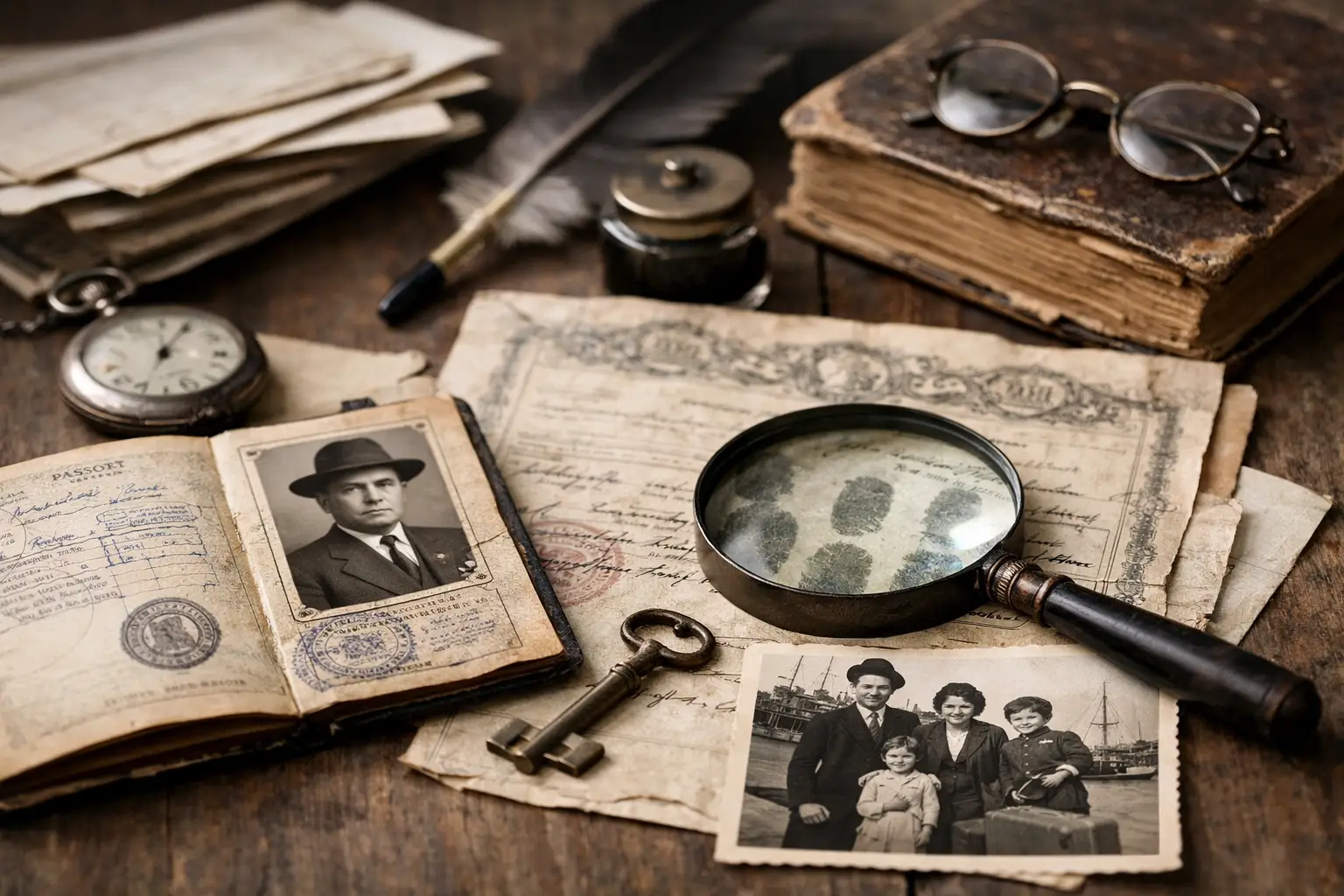

A faded passenger list. A naturalization paper folded into a family Bible. A marriage certificate with one unfamiliar place name. These are often the top clues in immigrant family documents, and for many families of Slovenian descent, they are the first real bridge between a remembered surname and a real village, parish, or homeland.
What makes these records so valuable is not just the main fact they appear to contain. It is the small details around the edges – the witness name, the last residence, the occupation, the sponsor, the spelling that looks slightly off. One record rarely tells the whole story. But several records, read carefully and together, can begin to trace the path from a life abroad back to a specific place in Slovenia.
Why the top clues in immigrant family documents matter
Many descendants begin with a simple question: where exactly did my family come from? That sounds straightforward, but immigrant records often reflect language barriers, changing borders, phonetic spellings, and the choices people made when adapting to a new country. A person who said they were from Austria in 1905 may have actually come from territory that is now in Slovenia. Another relative may later be described as Yugoslav, Slovenian, or simply Austrian depending on the year and the official asking the questions.
That is why document reading is part detective work, part historical context. The goal is not only to collect records. The goal is to identify clues strong enough to point to the right village, church books, archive collections, and family connections.
The best place names are often hidden in plain sight
The most prized clue in any immigrant file is usually the place of origin. But even when a document includes a location, it may not be complete. You might see only a region, a county, an old empire designation, or a place name written phonetically by a clerk who had never heard it before.
A death certificate may list a birthplace as “Austria.” That is historically possible but not yet helpful. A passenger manifest may narrow it to Carniola. A naturalization petition may name an actual town. A baptismal sponsor record from the old neighborhood church in America may mention the same village in a more familiar spelling. Once a place begins to repeat, confidence grows.
With Slovenian ancestry, this step requires patience. Village names may appear in German, Slovenian, Italian, or older administrative forms. Some places were also recorded under parish names rather than the village itself. It depends on who gave the information and how well they knew it.
What to watch for in place references
Look beyond the obvious birthplace field. A record may also mention last residence, nearest relative in the old country, destination contact, military district, or parish. Sometimes the exact home village appears in one of these secondary fields rather than in the main birthplace line.
If a document gives only a larger city, that is still useful. People often named the nearest recognizable place instead of a tiny village. That does not end the search. It simply means the next step is to look at surrounding communities and related parish jurisdictions.
Names can change, but patterns usually remain
One of the strongest clues in immigrant family documents is the way a name shifts over time. This can frustrate families at first, especially when the surname in America does not match the spelling found in European records. But name variation is normal, not suspicious.
Given names were often translated or adapted. Jozef became Joseph. Marija became Mary. Franc might appear as Frank. Surnames might be shortened, respelled, or standardized in a new country. What matters is not perfect consistency. What matters is whether the surrounding details line up.
A passenger list for “Ivan Kranjc” may connect to a naturalization file for “John Krainz” if the age, occupation, destination, and relatives all fit. In Slovenian research, this flexibility is especially important because many names moved through several languages before they reached the final version a family knows today.
Pay attention to women’s names and witnesses
Married women can be harder to trace because maiden names are often omitted in later records. Yet maiden names are among the most valuable clues for identifying the correct parish and extending the line backward. Marriage certificates, children’s birth records, obituary notices, and church registers may preserve them when other sources do not.
Witnesses and godparents matter too. Immigrants commonly traveled, settled, and worshipped with people from the same village or neighboring area. A witness with a familiar surname may be a sibling, cousin, in-law, or neighbor from the old country. Those connections can solve problems that a single direct-line record cannot.
Dates are not always exact, but they still tell a story
A birth date in family memory may differ from a draft card, tombstone, and naturalization petition. That does not mean the records belong to different people. Many immigrants estimated dates, celebrated name days instead of birthdays, or adapted details over time.
Still, dates are powerful when used comparatively. An arrival year can lead to a ship manifest. A marriage date can place a family in a certain city parish. A child’s birth can show when the family had already settled in a new community. Even a broad timeline can help separate two men with similar names.
For that reason, it is wise to build a chronology rather than trust any one document completely. The pattern across records usually matters more than a single precise date.
Occupations, addresses, and destinations often connect families
Some of the top clues in immigrant family documents are easy to overlook because they do not seem emotional or ancestral at first glance. Occupation is one of them. A miner, shoemaker, laborer, or railroad worker may appear in record after record, helping confirm identity across countries and decades.
Street addresses matter in the same way. Census pages, city directories, draft registrations, and church records can place relatives in the same building or neighborhood. If several households with related surnames lived near one another, that can suggest kinship or a shared village background.
Passenger manifests are especially rich here. They often name the person the immigrant was going to join in America and the nearest relative left behind. Those two names create a transatlantic chain. If the destination contact in Pennsylvania matches the brother listed on a later obituary, and the old-country relative carries a surname known in the family, you are no longer looking at isolated facts. You are seeing a family network.
Naturalization records can be more useful than families expect
Many people assume naturalization papers are only about citizenship. In reality, they can be among the most revealing records in an immigrant’s file. Depending on the time period, they may include birth date, place of birth, arrival details, ship name, current residence, occupation, spouse, and children’s names.
The trade-off is that not every immigrant completed the process, and not every court recorded the same level of detail. Earlier declarations can be sparse. Later petitions are often richer. Women and children may appear under the status of a husband or father rather than in their own files. Even so, these records are often worth the effort because they can tie together personal identity, migration timeline, and origin.
Church records abroad can preserve what civil records missed
For Slovenian families in particular, church records created after immigration can carry precious details from the old country. A marriage in a Slovene parish in Cleveland or Chicago might identify a bride and groom by village, parish, or even parents’ names. Baptism records for their children may list sponsors from the same hometown circle.
This matters because immigrant communities often carried memory through the church long after official papers had become simplified. A county clerk may have written “Austria.” A parish priest who spoke the language may have written the actual home place.
That is one reason heritage research is rarely about one famous document. More often, it is about reading ordinary records with enough care to hear what the family was still trying to say.
When one clue is enough to begin returning home
Not every family starts with a box of well-preserved papers. Some begin with almost nothing – a surname, a photograph, a story about a grandfather who never spoke much about where he came from. But even one strong clue can begin the journey.
A village name on a manifest can lead to parish books. A maiden name can identify the right household. A witness can reveal a sibling line. Once a place in Slovenia becomes more than a guess, family history changes. It stops being abstract. It becomes local, grounded, and visitable.
That is the quiet power of these records. They do more than document migration. They help families reconnect with roots in a way that can eventually be felt on the ground – in a church register, at a village cemetery, on the road where an ancestor once lived. If you are reading your family papers now, read slowly. The clue that brings you home may already be there.