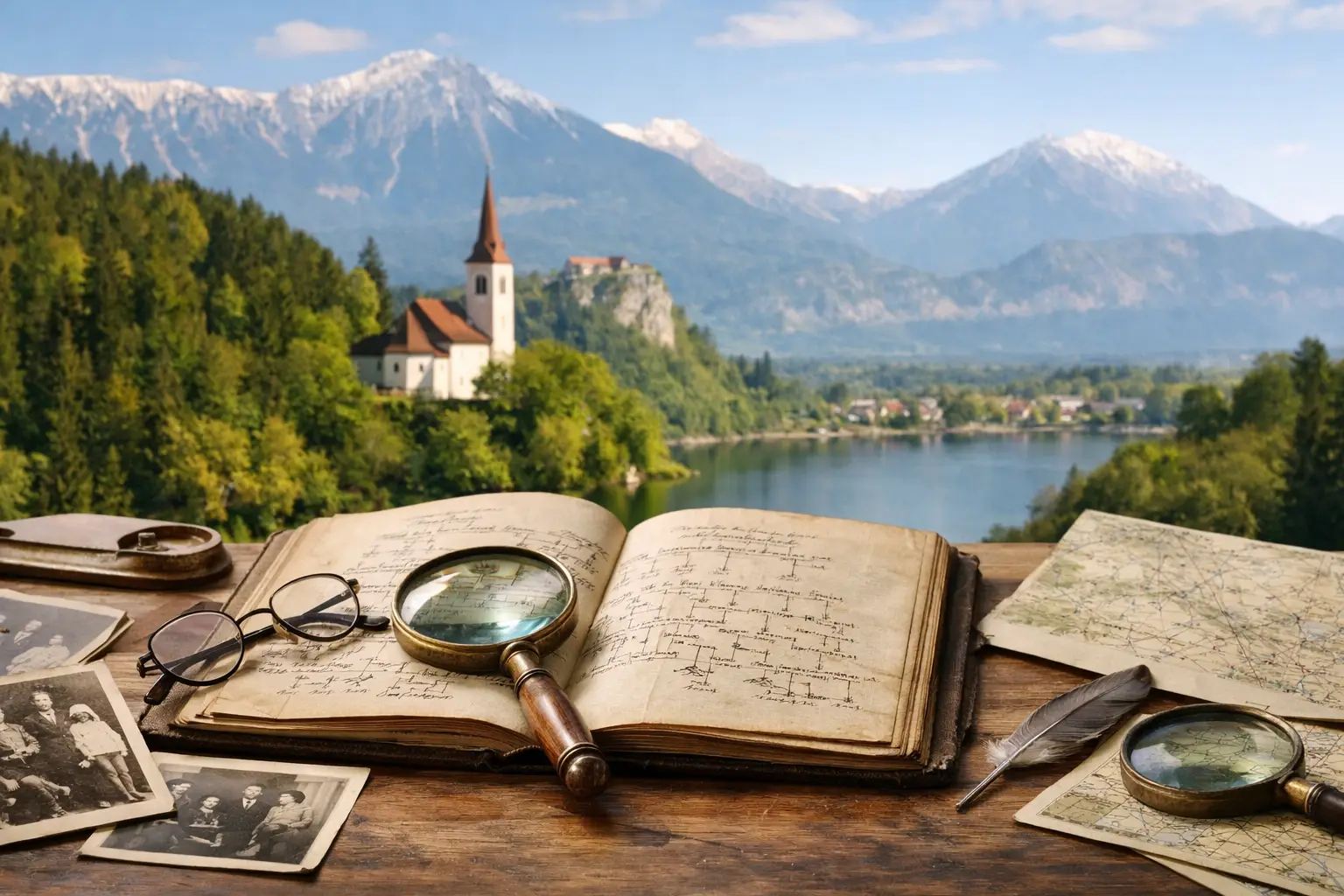


A handwritten surname on the back of an old photo, a baptism name nobody can quite pronounce, a story about a village “near Ljubljana” – this is often where a Slovenian ancestry research guide truly begins. For many families abroad, the first clues are incomplete, misspelled, or wrapped in memory. That does not make the search impossible. It makes it personal.
For descendants of Slovenian immigrants, ancestry research is rarely just about building a family tree. It is about returning to a place your family once left, understanding why they left, and reconnecting with the people, churches, landscapes, and traditions that shaped them. The most meaningful research does more than confirm dates. It helps you identify the exact village, parish, and region that can turn family history into a real journey.
Why a Slovenian ancestry research guide matters
Slovenian genealogy has a few qualities that make it both rewarding and challenging. Slovenia is small, but its historical records reflect shifting borders, changing place names, and multiple languages. Depending on the time period, your ancestors may have been recorded in Slovenian, German, Latin, or Italian. A surname may appear in several spellings, and the place your family called home may have been listed under an older administrative name rather than the one used today.
That is why a clear process matters. Without one, families often gather records but still cannot answer the question that matters most: where exactly did our people come from? Once that place is identified, the search becomes much more grounded. You are no longer tracing abstractions. You are following your family back to a particular hillside village, parish church, cemetery, or farmhouse road.
Start with family memory before archives
The strongest research often begins at the kitchen table, not in a repository. Before searching historical records, gather every detail your relatives remember. Even partial stories can become useful later. A grandfather’s original surname, a confirmation name, a port of departure, a parish feast day, or a neighboring town mentioned in a letter can all help narrow the field.
Pay close attention to names as they were spoken, not just as they were written in English-speaking countries. Slovenian surnames and given names were often changed after immigration. Jožef might become Joseph. Marija might become Mary. A surname ending in -ič might lose its accent or be simplified entirely. These shifts are common, and they can hide the trail if you assume the American form is the original one.
Family documents deserve the same careful attention. Review death certificates, marriage records, naturalization papers, passenger lists, church records, obituaries, old passports, funeral cards, and inscriptions on family graves. One small detail – especially a birthplace or parents’ names – can connect generations that once seemed impossible to link.
The key goal is finding the ancestral village
In Slovenian genealogy, the ancestral village matters more than many beginners expect. A country-level answer is not enough, and even a town name may be too broad. Most older records were organized locally, often through parishes. If you do not know the correct village or parish, your search can stall quickly.
This is one reason research can feel frustrating at first. Families may know they are “from Slovenia,” but their ancestors may have left before Slovenia existed as an independent country. They may have identified with a region such as Carniola, Styria, Primorska, or Prekmurje, or they may have said Austria, Yugoslavia, or Austria-Hungary depending on when they emigrated. All of that can be historically accurate, but it can also blur the path.
A village name, even an imperfect one, changes everything. It lets you connect your family to parish registers, local cemetery records, land history, and the geography your ancestors knew firsthand.
What records to look for in Slovenian ancestry research
Once you have basic family clues, focus on records that bridge the immigrant generation to the old country. US and overseas records are often the fastest route back to Slovenia because they were created closer to the family’s migration and may name a birthplace more precisely.
Naturalization files can be especially valuable because later versions often requested exact birthplaces. Passenger manifests may list a last residence or the name of a relative left behind. Church marriage and baptism records in immigrant communities sometimes preserve original village names that civil records omitted.
After that, parish registers become central. Baptism, marriage, and burial records can help establish family groups across generations. Civil registration may also help, depending on place and period, but parish records remain essential in much of Slovenian ancestry research.
Military records, cadastral material, and probate or land-related records may also add depth once the family origin is known. These sources usually do not replace parish work. They enrich it. They can show social standing, property ties, movement between households, and the wider story of how a family lived.
Language, borders, and spelling changes
This is where many people worry they will get lost, and that concern is understandable. Slovenian family history does not always present itself neatly in one language or one map.
A village may have a Slovenian name and an older German version. A parish register might be in Latin. A family story recorded in Cleveland or Buenos Aires may preserve a place name by sound rather than by spelling. None of this means the trail is gone. It means interpretation matters.
It also means you should be cautious about quick assumptions. Two villages can share similar names. One surname can appear across several regions. And an immigrant who said he was from “Ljubljana” may have meant the nearest recognizable city rather than his true home village. Good research balances hope with restraint. It is better to confirm slowly than attach your family to the wrong place.
A practical Slovenian ancestry research guide for beginners
If you are just starting, think in stages rather than trying to solve everything at once. First, identify the immigrant ancestor in your line and gather every record created after arrival abroad. Then compare names, dates, religion, and any mention of birthplace. From there, test possible village and parish matches before moving into older records in Slovenia.
This sequence matters because it reduces mistakes. Many beginners jump straight to online databases in Europe and end up following someone else’s family. The safer path is to prove each link from the known generation to the earlier one.
If your family was Roman Catholic, parish records may be especially fruitful. If your ancestors belonged to another denomination, the record path may differ. That is one of the places where research becomes less universal and more local. The right strategy depends on time period, region, religion, and what survived.
When research turns into a heritage journey
There comes a moment in many family searches when the question changes. At first, people ask, “Can I find my ancestors?” Later, they begin asking, “Can I stand where they stood?”
That shift matters. Once an ancestral village is identified, the research becomes more than a document project. You can visit the parish church where baptisms were recorded, the cemetery where earlier generations may rest, the valley your family crossed on foot, or the town market that shaped daily life. Even when a house no longer stands or a surname has faded from the village, the place itself still carries meaning.
This is where heritage travel becomes so powerful for descendants abroad. The records provide evidence, but the landscape provides recognition. A narrow road, a church bell, a mountain view, or a local surname on a mailbox can make family history feel immediate in a way no chart ever could.
For many travelers, this is also an emotional return. You may be the first in your family to come back after a century or more. That experience can be joyful, tender, and sometimes unexpectedly heavy. It helps to approach it with patience rather than a scripted expectation. Some journeys bring dramatic discoveries. Others bring quiet confirmation. Both are meaningful.
Knowing when to ask for help
There is real value in doing your own early research. It helps you understand your family story and gather the material only your relatives can provide. But there is also a point where local expertise can save enormous time.
That is often true when place names are uncertain, records require language interpretation, or a family wants to move from research to in-country visits. A Slovenia-specific guide can help connect archival findings with real places, local history, and practical travel planning. For families who want to do more than collect records, that bridge matters.
At Ancestry Slovenia, that is exactly where the work becomes deeply personal – helping descendants move from fragments and family memory to villages, parishes, and places that make the story feel like home again.
Your search does not need to begin with perfect information. It only needs a starting point, a willingness to follow the clues carefully, and the understanding that behind every record is a real place still waiting to be recognized.