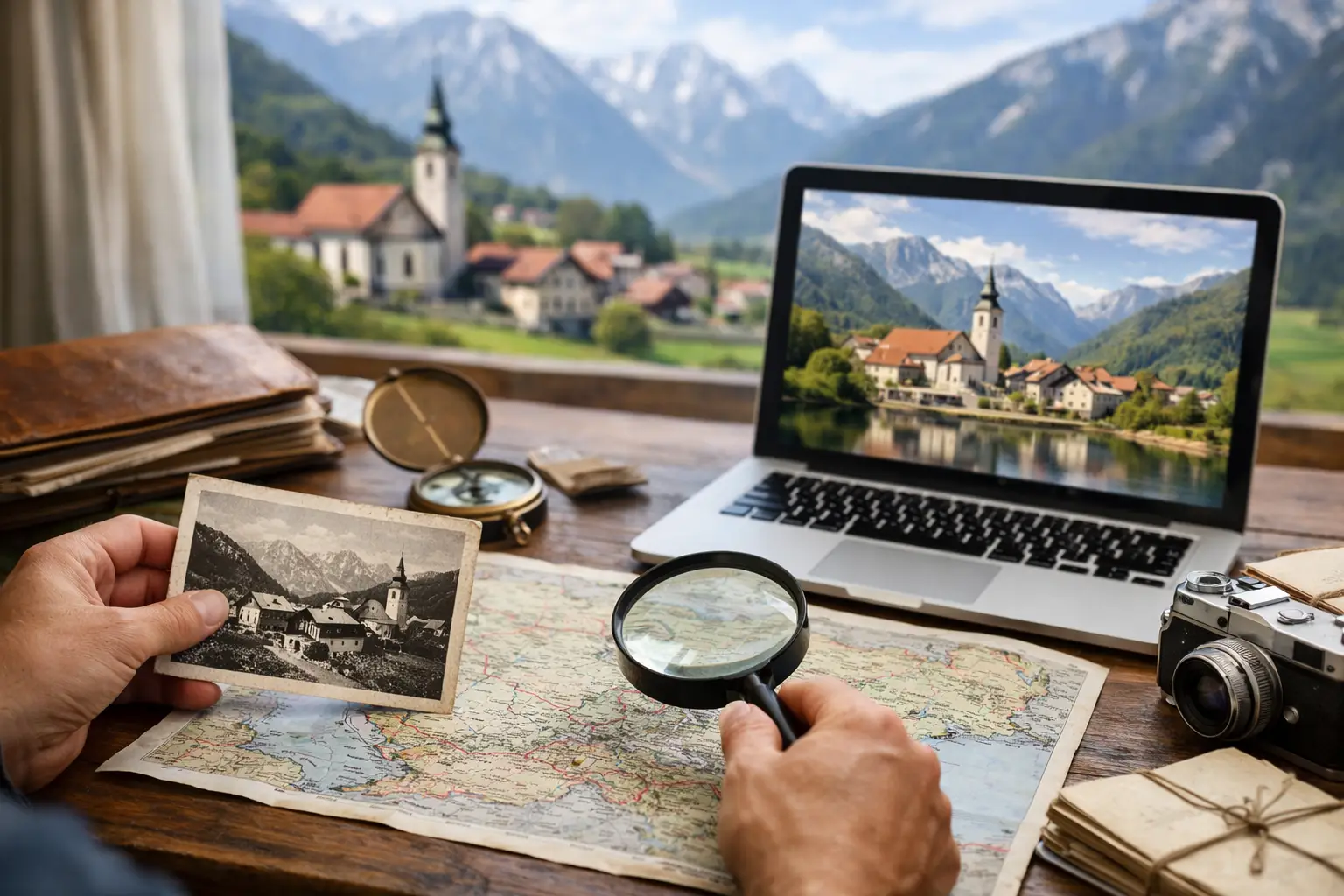

A handwritten surname on the back of an old photograph can feel small until you realize it may be the thread that leads you back to a real place. If you are trying to find my family village Slovenia, you are not just looking for a dot on a map. You are trying to reconnect names, stories, churches, homes, and landscapes that once shaped your family.
For many Slovenian descendants abroad, the search starts with uncertainty. A grandparent may have said “near Ljubljana” or “from Carniola,” which sounds helpful until you discover how many villages, parishes, and old regional borders are involved. The good news is that village-of-origin research is often possible, even when the clues seem incomplete. The key is knowing how Slovenian records work, how place names changed over time, and how to connect family memory with documentary evidence.
How to find my family village Slovenia when you have very little
Most people begin with fragments. A surname, an immigration year, a saint’s card, or a naturalization paper may be all you have. That is normal. In Slovenian genealogy, small details matter because one clue often confirms another.
Start with family sources before moving to archives. Ask relatives for old passports, funeral cards, marriage certificates, military papers, letters, prayer books, and the backs of family photographs. Listen carefully to pronunciation if an elder remembers a village name. A place written one way in English records may have appeared very differently in Slovene, German, Italian, or even in an older handwritten form.
This is where patience matters. “Gottschee,” for example, points to a historical German-speaking region in present-day Slovenia, not a single village. “Austria” on a US record may actually refer to a Slovenian birthplace because many ancestors left when the area was part of the Austro-Hungarian Empire. A family story can be true and still need translation into historical geography.
Begin with the records created after emigration
If your ancestor settled in the United States, Canada, Argentina, or Australia, records in the new country often provide the first reliable lead to the original village. Passenger lists, death certificates, obituaries, naturalization records, church marriage records, and tombstones can all contain birthplace clues.
Naturalization files can be especially valuable because later forms sometimes asked for the exact town of birth rather than just the country. Passenger manifests may list the last residence, the nearest relative left behind, or the destination contact. Those details can connect a person to a parish or municipality even if the village name is misspelled.
Church records abroad are also worth close attention. Slovenian immigrant communities often preserved more precise identity markers than civil records did. A parish marriage entry might name the home village, while a death certificate only says “Yugoslavia.” When several records point in the same direction, confidence grows.
Use surnames carefully, not hopefully
Families often begin with a surname because it feels personal and familiar. That makes sense, but surname research has limits. Some Slovenian surnames are strongly associated with certain areas, while others appear across the country. A surname alone rarely proves village origin.
What it can do is narrow possibilities. If your family name appears frequently in a specific parish in the late 1800s, that is a useful lead. If the given names repeat in the same family pattern across baptism, marriage, and burial records, the case becomes stronger. Still, this is a process of correlation, not guesswork. The goal is not to pick a village that sounds right. The goal is to identify the right village because the evidence points there.
Historical regions can hide the answer
One reason this search feels difficult is that older documents often name a region rather than a village. Slovenian ancestors may have identified with Carniola, Styria, Carinthia, the Littoral, Prekmurje, or another historical area. Those regions mattered deeply, but they are not specific enough for heritage travel planning or parish research.
A record that says “Krain” is pointing to Carniola, not telling you the exact birthplace. A note saying “near Marburg” may refer to Maribor under its historical German name. Italian, German, Latin, and Slovene place forms can all appear in the same family trail. Understanding those layers is often what turns a dead end into a clear location.
Find my family village Slovenia through parish records
Once you have a likely area, parish records are often the bridge from broad geography to a precise ancestral village. Baptism, marriage, and burial books in Slovenia frequently include villages of residence, house numbers, parents’ names, and witnesses. Those details help distinguish one family from another with the same surname.
This is especially important because Slovenian villages can be small and clustered closely together. A person might have been born in one village, married in another, and buried in a parish center that served several settlements. Looking at just one event can mislead you. Looking across a family group usually clarifies the pattern.
House numbers can be surprisingly powerful. In some places, the farm or household remained associated with the same family for generations. If you can tie your ancestor to a house number in a village, you are no longer dealing with a vague homeland story. You are approaching a specific place where your family once lived their daily life.
Why spelling variations matter so much
Many descendants search for a village exactly as it was pronounced in family memory, then assume the place no longer exists when nothing appears. Often, the village does exist. It is simply hiding behind a changed spelling.
Slovenian names were often altered by immigration officials, priests, census takers, or family members adapting to English. Diacritical marks disappeared. Endings shifted. German and Italian versions were used in older records. Even within Slovenia, a village may appear in Latin in one church book and German in another.
That is why phonetic thinking helps. If a grandmother said something that sounded like “Shent Vid,” you may be looking for Šentvid. If a manifest says “Laibach,” it refers to Ljubljana. The right interpretation depends on time, language, region, and the type of record.
When family stories are accurate, but incomplete
Some of the most meaningful searches begin with a story that sounds frustratingly vague. “Our people came from the hills.” “There was a church on the ridge.” “They left because there was no land.” These memories may not name a village, but they often preserve context that records later confirm.
A mountainous setting may suggest Upper Carniola or parts of Styria. A memory of vineyards may align with eastern Slovenia or the Littoral. A family tradition of crossing the ocean from Trieste may fit migration patterns from several Slovenian regions. Story alone is not proof, but it gives shape to the research and helps explain why your ancestors left.
This emotional dimension matters. Finding the village is not just a research win. It helps descendants understand the texture of inherited memory – the landscape, faith, poverty, work, and community their family carried with them across continents.
What happens after you identify the village
Once the village is confirmed, the search often changes from genealogy to homecoming. You can begin locating the parish church, cemetery, old cadastral maps, family homes, local archives, and nearby towns your ancestors would have known. Even if the original house is gone, the setting remains. Roads, fields, church towers, and valley views still hold the shape of family history.
This is where research-guided heritage travel becomes deeply personal. Visiting without prior documentation can still be moving, but visiting with names, dates, house references, and parish ties creates a different experience. You are not simply seeing Slovenia. You are standing where your family belonged.
For many travelers, that moment is quieter than expected. It is not always dramatic. Sometimes it is the sound of church bells, a surname on a grave marker, or the realization that a place long spoken of in fragments is real and still present. That is often when family history stops being abstract.
If your search feels stalled, expert guidance can save years of uncertainty. A Slovenia-focused research process can interpret old place names, match records across languages, and connect documentary findings with the places you may one day visit. At Ancestry Slovenia, that bridge between evidence and experience is at the heart of the journey.
You do not need to begin with perfect records. You only need a starting clue and the willingness to follow it carefully, because the village you are looking for may be closer than your family story has led you to believe.