A single baptism entry can do far more than confirm a birth date. It may preserve the house number where your great-grandmother entered the world, the maiden name of her mother, the relatives trusted as godparents, and the parish community that shaped your family for generations. Understanding Slovenian baptism records meaning turns a page of unfamiliar handwriting into a doorway back to a very specific place.
For descendants abroad, these records often carry the first solid clue that moves a family story beyond a surname and into a village, a hillside, or a church your ancestors knew by name. They can be wonderfully detailed, but they also require patience. Slovenian lands were governed by different states over time, and parish priests commonly recorded information in Latin, German, Slovenian, or occasionally Italian and Hungarian, depending on the region and period.
What a Slovenian baptism record usually tells you
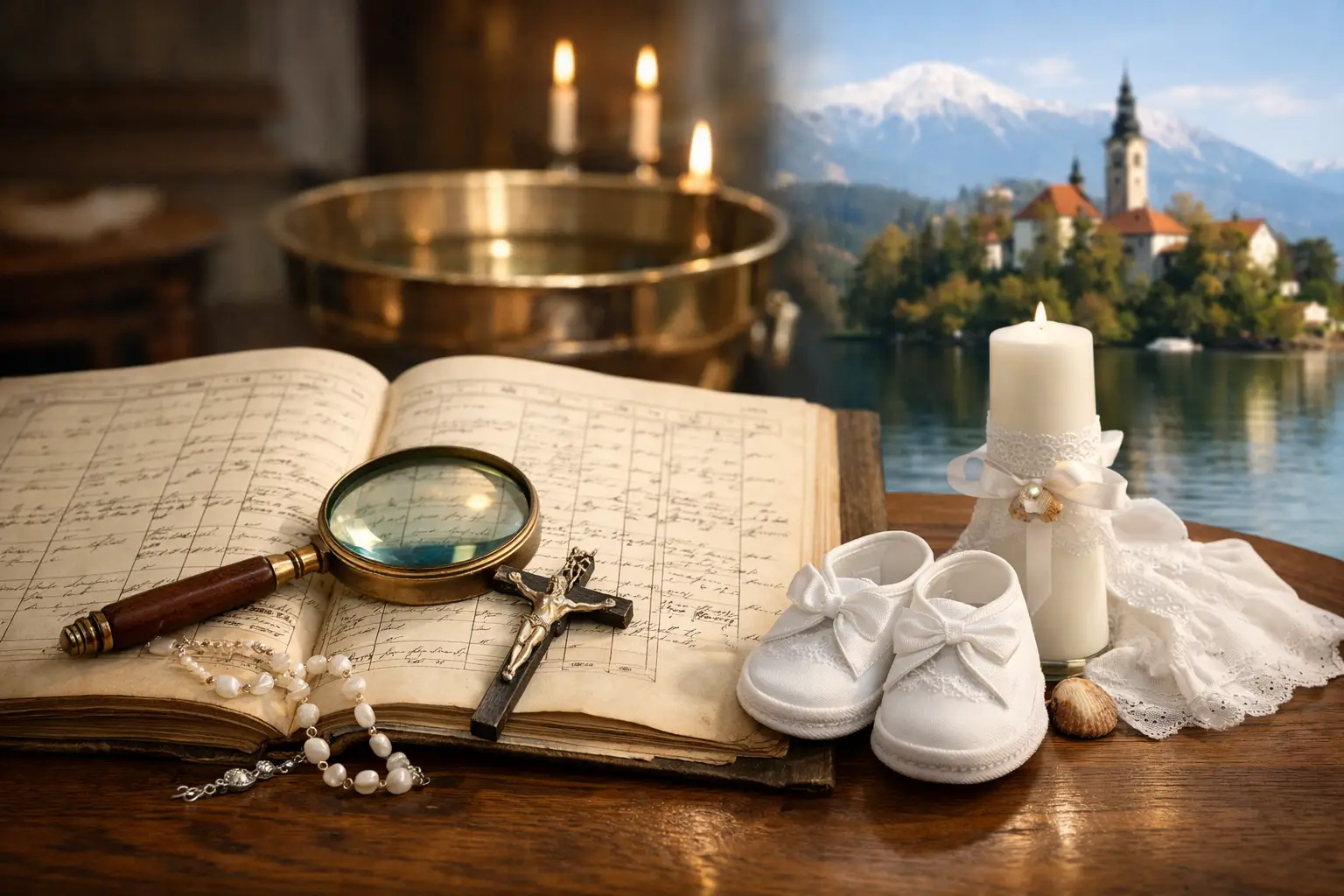
A baptism record, often called a birth-and-baptism entry, was created by a parish priest after a child was baptized. In Catholic communities, baptism generally took place soon after birth, especially in earlier centuries. That makes the record one of the most reliable starting points for tracing a family line before civil registration became widespread.
Most entries include the child’s given name, date of birth, date of baptism, parents’ names, and the family’s residence. Many also identify the father’s occupation, whether the child was legitimate, and the names of one or more godparents. Older records may be written as a short paragraph; later parish registers often use ruled columns, making recurring details easier to spot.
The meaning lies not only in the words but in the relationships recorded around the child. A godparent was rarely a random witness. Often, this person was a grandparent, aunt, uncle, older sibling, cousin, neighbor, or respected member of the same village. Following godparents across several baptisms can reveal a kinship network when direct evidence is incomplete.
Reading Slovenian baptism records by language and era
The language of a record does not necessarily reflect how your ancestors spoke at home. A Slovenian-speaking farming family might appear in a Latin parish register, while the same family may be recorded with Germanized names in a later administrative document. This is a normal part of research in a region shaped by Habsburg rule, shifting borders, and local church practice.
Latin terms you will see often
Latin is especially common in older Catholic registers. A few recurring terms can make an entry much less intimidating. Natus or nata refers to a child who was born, while baptizatus or baptizata means baptized. Filius means son and filia means daughter. Pater and mater identify the father and mother.
You may see legitimus or legitima, meaning born to married parents. Terms such as illegitimus were used for a child born outside marriage. These words can feel stark to modern readers, but they reflect the church’s recordkeeping categories of the time, not the worth or place of that ancestor in your family story.
Godparents may be labeled patrini, sponsores, or a similar term. The priest might also use abbreviations, so context matters. If a name appears after the parents and before the priest’s signature, it may belong to a sponsor rather than another relative.
German names and place forms
In many nineteenth-century records, German appears in headings, occupations, and place names. Slovenian personal names were often rendered in a German form. Janez may appear as Johann, Jožef as Josef, and Jernej as Bartholomäus or Bartl. A woman known within the family as Marija might be written as Maria.
This does not mean you have found a different family. It means you need to search by sound, location, house number, and relatives rather than relying on one spelling. Surnames also shifted in form. A priest might use a Slovenian ending in one entry and a Germanized version in another, sometimes within the same register.
Why the house number may be your best clue
If you find a number beside your ancestor’s residence, do not overlook it. Historic house numbers were often assigned within a village or parish and can help distinguish two families with the same surname. In a small community, several men named Anton Kovačič may have lived at the same time. The family at house number 12 could be entirely separate from the family at house number 43.
House numbers were not always permanent street addresses in the modern sense. They could change after renumbering, rebuilding, municipal reorganizations, or division of a farm. Still, when matched with parish, occupation, and neighboring families, they can be remarkably powerful. They may help connect baptisms, marriages, burials, land records, and the physical location of an ancestral home.
For heritage travel, this is where research begins to feel tangible. A house number can lead toward the hamlet where an ancestor was born, the parish church where the baptism took place, and the landscape your family left behind when they emigrated.
How to interpret parents’ names correctly
A baptism entry typically lists the father first, followed by the mother. The mother’s maiden surname is particularly valuable because it opens another family line. But read carefully: some registers use the wife’s married name in one place and her maiden name in another. Others add the name of her father, especially in more detailed entries.
Pay attention to descriptors after a parent’s name. They may identify an occupation such as farmer, laborer, tailor, miller, or innkeeper. They can also identify social status or residence. These details help separate people with common names and add texture to the life behind the record.
A father’s name may be omitted in cases of an unmarried birth, or later added after a marriage or legal acknowledgment. Avoid filling gaps with assumptions. One unusual entry can point to a family circumstance that deserves careful, respectful research through later marriage records, confirmations, or court and civil documents.
Dates are clues, not always simple answers
Birth and baptism dates can be close together, but not always. Illness, weather, distance from church, or local custom could affect timing. If a child was baptized on the day of birth, that may indicate concern for the infant’s health, though it should not automatically be treated as proof.
Also consider calendars and transcription issues. Slovenia used the Gregorian calendar during the periods most descendants encounter in parish research, but copied indexes and family papers may introduce errors. A date that seems impossible may be a misread numeral, an abbreviated month, or a later transcription mistake.
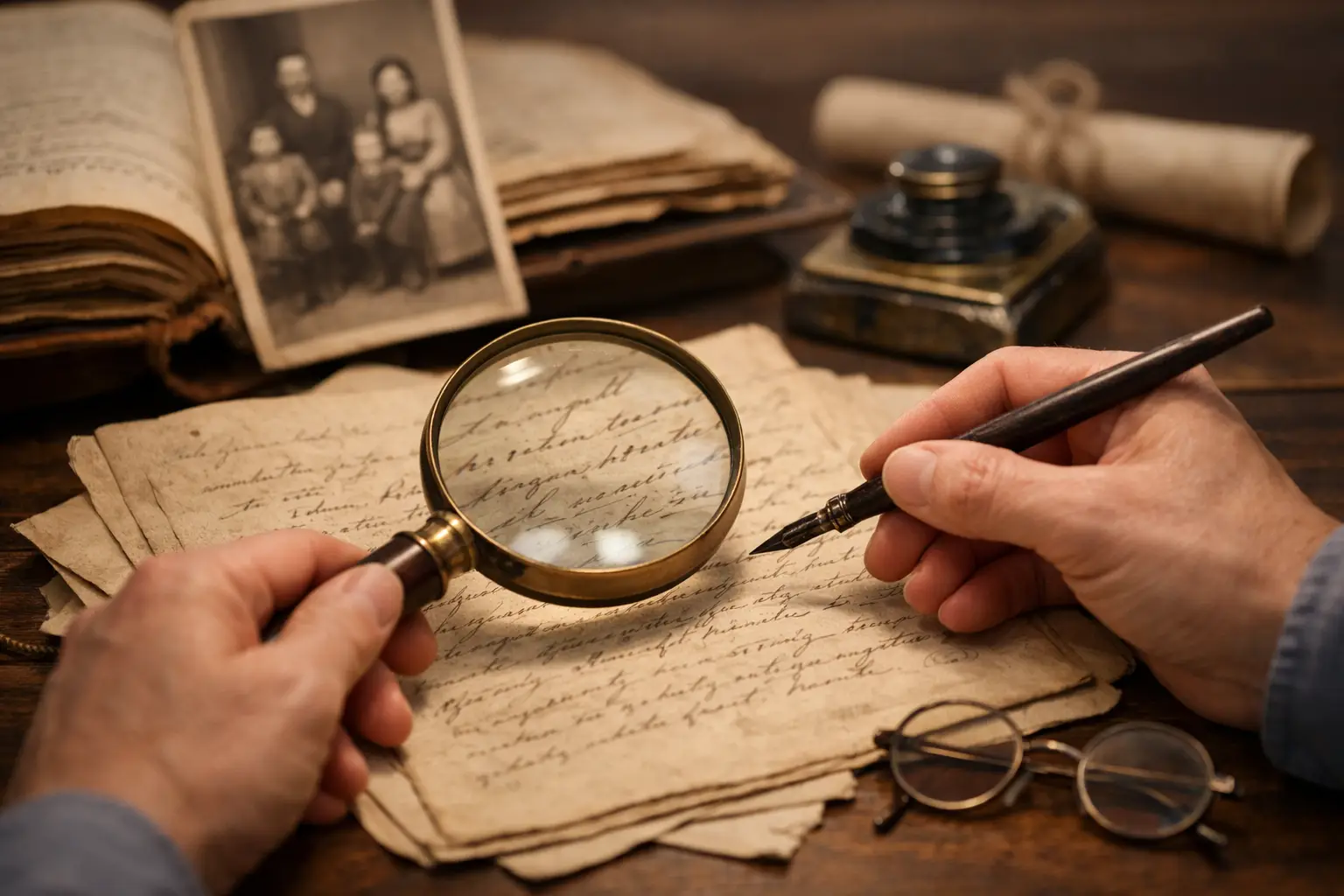
The priest’s handwriting is another practical challenge. Do not force yourself to decipher every word at once. Start with what you can identify: dates, house numbers, repeated surnames, and familiar given names. Compare letters with other entries on the same page. A word that is unclear in your ancestor’s entry may be perfectly legible three lines below.
A careful way to use the record in your family research
Treat each baptism as one piece of evidence, then build outward. Record the parish name exactly as written, along with the village, house number, parents, godparents, dates, language, and page or entry number. Preserve the original spelling before adding a modern or familiar version in your notes.
Next, look for siblings baptized in the same parish. Repeated godparents, recurring house numbers, and a consistent occupation can confirm that you are following the right household. Then compare the family with marriage and burial records. This is especially important when a surname is common or when several nearby villages share similar place names.
It also helps to understand parish boundaries. Your ancestor may have lived in a small settlement but attended the church in a neighboring village. The village named in an American obituary, family letter, or naturalization paper may not be the parish where the baptism was recorded. Research becomes more accurate when you distinguish the home settlement from the church jurisdiction.
When a baptism record becomes a return home
The most moving part of Slovenian genealogy is often not the translation itself. It is realizing that a brief entry, written by a parish priest long ago, names the people who stood beside your ancestor at the beginning of life. It places a family within a community of fields, homes, church bells, and familiar faces.
If a record gives you a parish, a house number, or a cluster of relatives but leaves questions unanswered, that is still meaningful progress. Keep the details together, let the evidence guide the next step, and allow the story to unfold at its own pace. One baptism record may be the small, enduring thread that leads your family back to the Slovenian place that still feels like home.