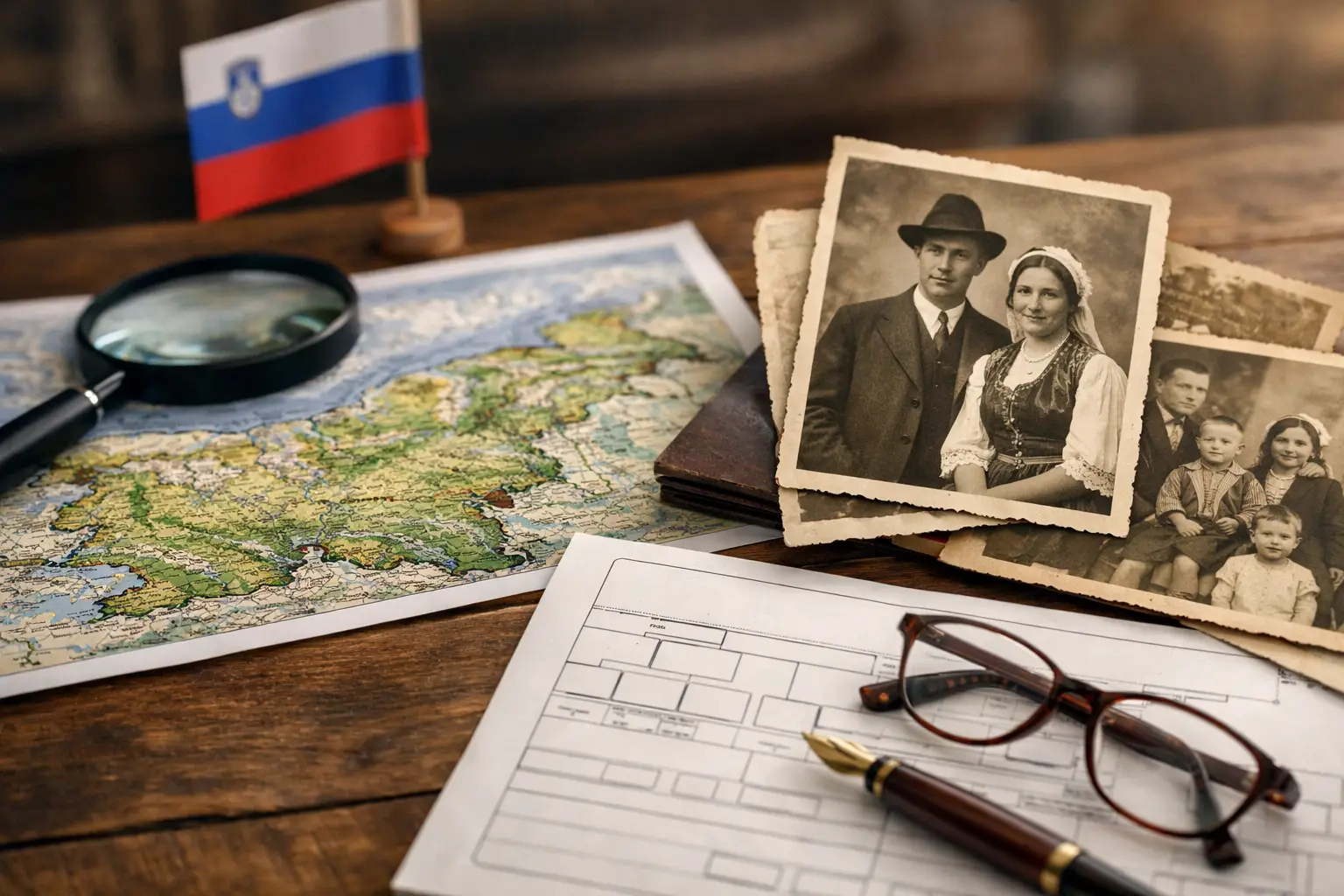
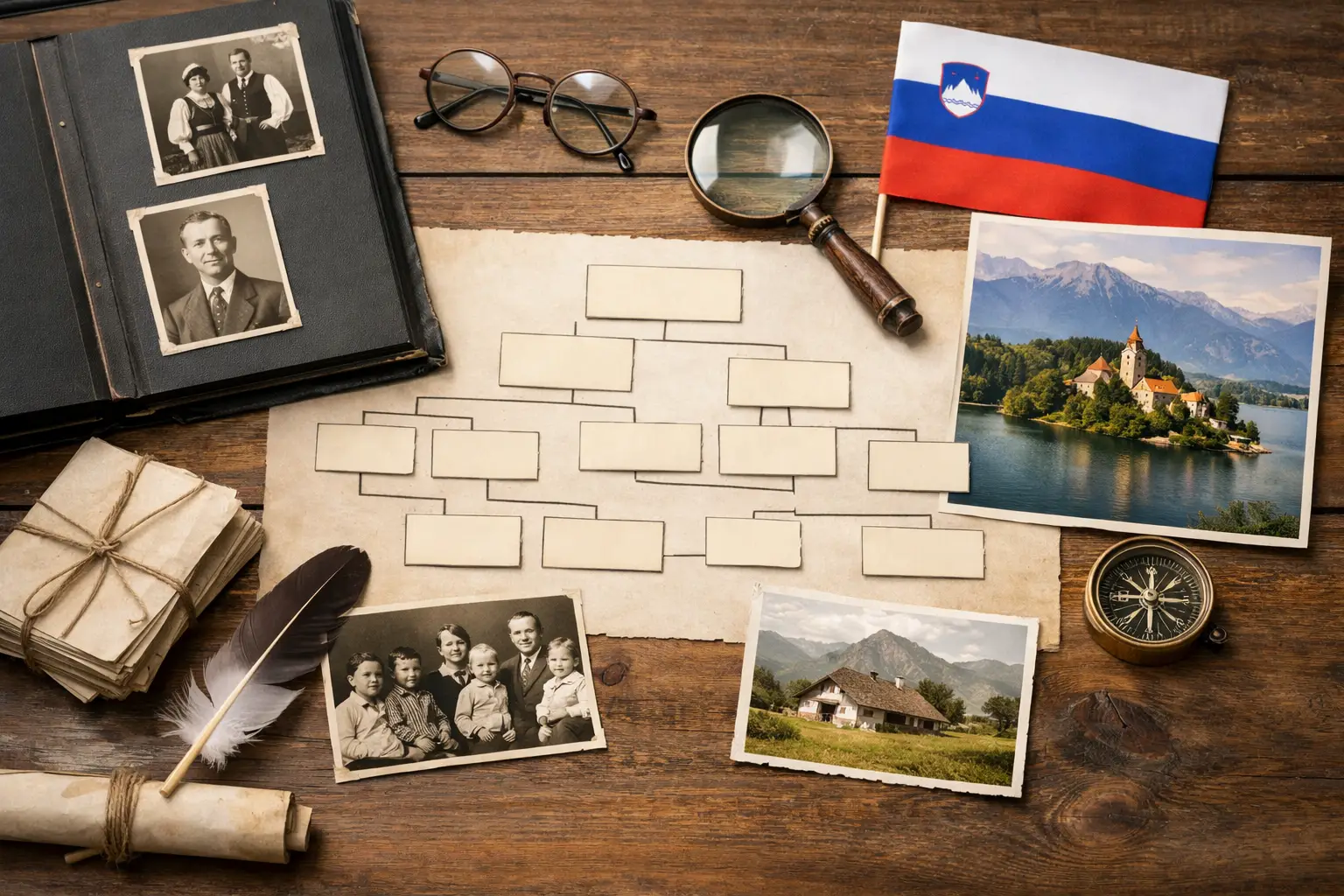


A faded photograph with a name on the back, a remembered village pronunciation, a ship manifest, or a grandparent’s favorite Slovenian dish can hold the first thread of a much larger story. When you build a Slovenian family timeline, you give those scattered clues an order. More than a chart of births and deaths, it becomes a way to understand what your family endured, celebrated, left behind, and carried across an ocean.
For descendants abroad, that timeline can also become the foundation for a journey to Slovenia. A date of baptism may lead to a parish church. A marriage record can identify the village where two family lines came together. An emigration year may reveal the economic and political pressures that shaped a life-changing decision. Slowly, family history moves from a collection of names into a story rooted in real places.
Begin Your Slovenian Family Timeline With What You Know
Start close to home. Before searching archives, gather the documents and memories already held by relatives. Even incomplete information is useful. A surname, a maiden name, a nickname, a town written with an unfamiliar spelling, or an approximate year of arrival in America can point research in the right direction.
Speak with the oldest members of your family if you can. Ask open questions rather than only asking for dates. What did they call the old country? Did they mention a church, a nearby city, a river, or a region such as Gorenjska, Dolenjska, Primorska, Štajerska, or Prekmurje? Who emigrated first? Did siblings remain in Slovenia? These details often explain gaps that records alone cannot.
As you collect information, record each item with its source. A simple spreadsheet, family tree program, or paper timeline can work well. Include the person’s full name as written, the event date, the place, the source, and a short note about what is known or uncertain. Do not force precision where it does not exist. “Around 1885, believed to be near Novo Mesto” is more honest and more useful than a guessed exact date.
Work Backward From the Immigrant Ancestor
For many Slovenian American families, the best-documented person is the ancestor who emigrated. Begin with that individual and work backward, rather than starting with an assumed Slovenian village. US census records, naturalization files, death certificates, obituaries, cemetery inscriptions, marriage licenses, and passenger lists may all contain clues to the ancestor’s birthplace and family.
Place names deserve special attention. Slovenia has a great many small villages, and several may share the same name. An American record that says only “Austria” or “Yugoslavia” is not necessarily wrong. It reflects the political borders of the time. Much of present-day Slovenia was part of the Habsburg Empire before 1918, then became part of Yugoslavia after World War I. The country of origin on a record may change even when your family never moved.
Names may shift as well. Janez might become John, Jože might appear as Joseph, and Ana as Annie. Surnames could be simplified, misspelled by officials, or altered by the family after arrival. A timeline should preserve both versions where possible: the name used in Slovenia and the name used abroad. That dual record honors the person’s full identity and makes future searches easier.
Add Historical Context, Not Just Family Dates
A meaningful timeline has two layers. The first is personal: births, baptisms, marriages, military service, emigration, deaths, and reunions. The second is historical: the events that shaped the choices available to your ancestors.
If your family left in the late 19th or early 20th century, they may have been responding to limited farmland, work opportunities, military obligations, or the pull of relatives already established in Cleveland, Chicago, Pittsburgh, Minnesota, or elsewhere. If they came from the Littoral region, Italian rule after World War I may be part of their story. Families affected by World War II, postwar displacement, or later Yugoslav emigration have different historical landscapes to consider.
Context should illuminate rather than overwhelm the family story. You do not need to turn your timeline into a textbook. A brief note beside an emigration date can be enough: “Left the Habsburg Empire during a period of heavy emigration from rural Slovenian lands.” This helps younger relatives understand that an ancestor’s departure was rarely a simple decision.
Give each event a place
A date without a location is only half a clue. Whenever possible, record the smallest known place: village, parish, municipality, and region. The village may be essential because civil records and parish registers were organized locally.
Also note the historical form of the place name. A village could appear under a German, Italian, Slovene, or older administrative spelling depending on the year and the record keeper. Keeping these variants together prevents a common frustration: believing several records refer to different places when they actually describe the same ancestral home.
Use Slovenian Records Carefully and Patiently
Once you have a likely village or parish, the timeline can grow quickly. Slovenian parish registers are often the heart of pre-civil-registration family research. Baptism, marriage, and burial entries can reveal parents’ names, occupations, house numbers, witnesses, godparents, and causes of death. These are not minor details. A godparent may be a sibling, cousin, or neighbor who helps separate one family from another with the same surname.
Still, records require careful interpretation. Earlier entries may be written in Latin, German, Italian, or old handwriting that takes experience to read. Dates can be inconsistent. Ages in death records may be approximate. A surname may vary from one entry to the next. Treat every record as evidence to compare, not as a final answer in isolation.
House numbers can be especially valuable in Slovenian villages. They may show that several generations lived on the same farm or that a bride moved only a short distance after marriage. Yet house numbers can change over time, so they should be confirmed through multiple records when possible.
This is where focused local research can make a difference. A knowledgeable guide can help distinguish between villages with similar names, identify the relevant parish, read record conventions, and connect a paper trail to the landscape your ancestors knew.
Turn the Timeline Into a Family Story
After gathering dates and documents, resist the urge to leave them in a spreadsheet. Write short narrative entries for the people whose lives form the backbone of your family. You might write that your great-grandmother was baptized in a hill village, married in the parish church at 22, and remained behind while two brothers departed for America. Or that your grandfather crossed the Atlantic at 18, worked in a steel town, and continued sending letters and money home.
Be clear about what is documented and what is family memory. Both matter, but they play different roles. A note such as “Family tradition says he left after a disagreement with his father; emigration records confirm his departure in 1907” preserves the story without presenting an unproven detail as fact.
Include the lives of those who did not emigrate. The relatives who stayed in Slovenia are often the missing half of a diaspora family’s story. They cared for homes, fields, churches, and graves. Their descendants may still live near the ancestral village, or their memory may remain in local records and cemetery inscriptions.
Let Your Timeline Shape a Heritage Journey
A well-built timeline changes how you travel. Instead of asking only which famous sites to visit, you can ask more personal questions: Where was my great-grandmother baptized? Which road might my ancestor have walked to school or to market? Is the family farm still standing? Where are relatives buried?
Not every research project produces an exact house or a living cousin, and it is wise to allow for uncertainty. Villages have changed, borders have shifted, and some records may be missing. Yet even an approximate ancestral area can create a deeply moving experience when approached with care. Standing in the parish where your family marked generations of baptisms and marriages can make a century-old document feel immediate.
At Ancestry Slovenia, research-guided heritage travel is built around this connection between evidence and place. A family timeline helps shape an itinerary that respects the facts while leaving room for the unexpected moments that often matter most: hearing the local pronunciation of a surname, seeing a mountain view an ancestor knew, or placing flowers at a grave.
Save copies of your timeline in more than one place, and share it with children, cousins, and relatives who may hold the next missing clue. Leave room for revisions. Family history is not a finished monument. It is a living record, and every carefully preserved date can become a path back to the place your family once called home.