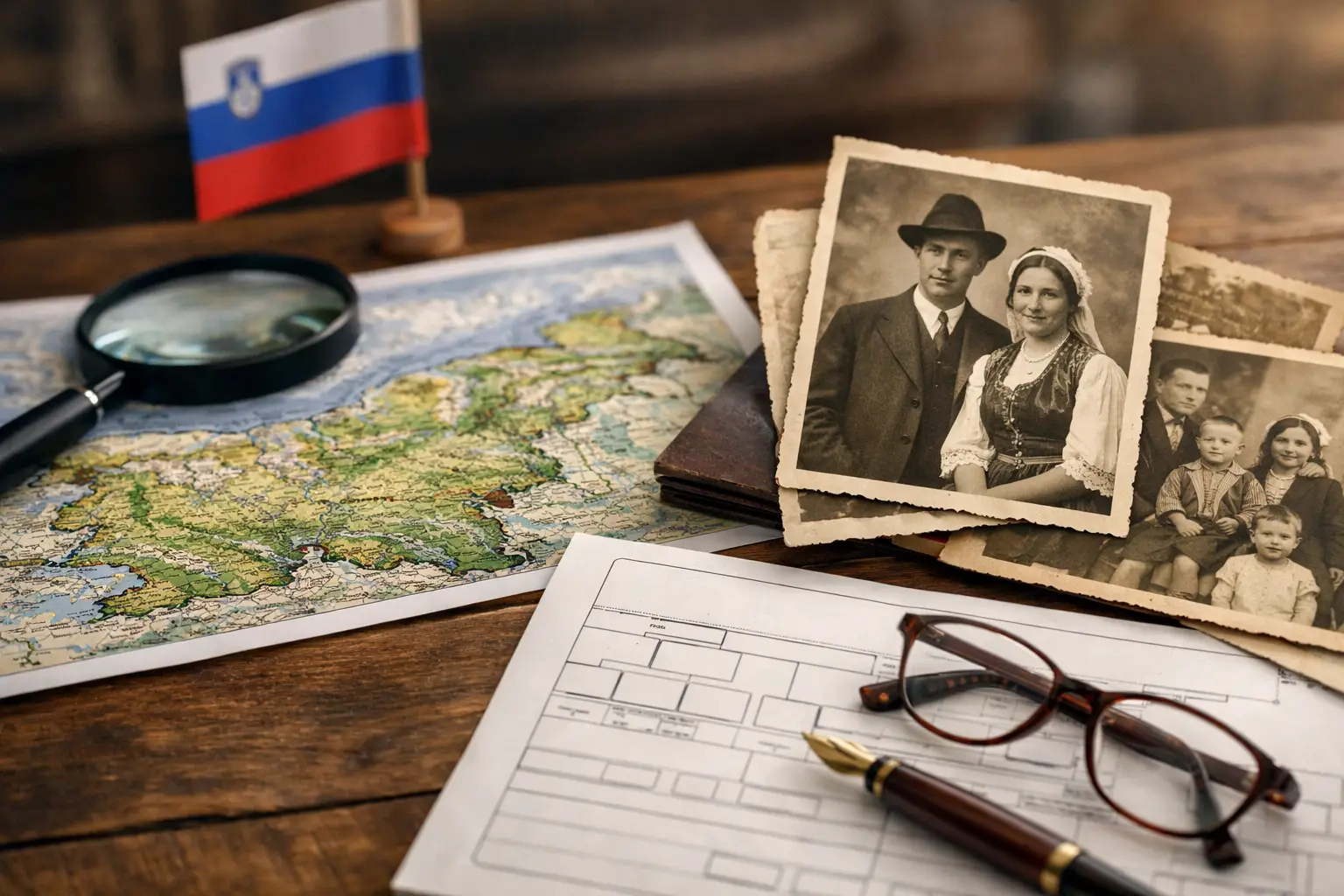

A handwritten surname in a family Bible. A faded photograph with a church steeple in the background. A grandmother who said the family came from “near Ljubljana,” though she never named the village. These are meaningful beginnings, but they can also leave families wondering where to go next. The choice between a professional researcher vs DIY genealogy is not about whether you care enough to do the work yourself. It is about deciding what kind of answers you need, how much uncertainty you can accept, and whether you hope to one day stand in the place your ancestors called home.
For descendants of Slovenian emigrants, genealogy often carries a special challenge. Family names changed at Ellis Island or in English-speaking communities. Old records may use German, Latin, Italian, Hungarian, or Slovene. Villages can have similar names, historical boundaries have shifted, and the most valuable details may live in parish registers or local archives rather than an online database.
What DIY genealogy can reveal
Doing your own research can be one of the most rewarding ways to begin. It gives you time with the stories, documents, and photographs your family has kept. You may discover that an immigration record lists a last residence, a naturalization file gives a birthplace, or a death certificate names parents you had never heard of.
For many families, the first stage is best done at home. Speak with older relatives while you can. Ask for maiden names, nicknames, family saints’ days, occupations, migration routes, and the names of nearby towns. Look through funeral cards, letters, military papers, old address books, and inscriptions on the back of photographs. A clue that seems small today may later identify the right village.
Online genealogy platforms and digitized records can help you assemble a working family tree, especially for relatives who lived in the United States, Canada, Argentina, or Australia. Census records, passenger lists, obituaries, and church documents can show how one generation led to the next. DIY research also gives you a personal understanding of the evidence behind each name.
The trade-off is that genealogy can become time-consuming once the trail crosses the Atlantic. A document may name only Austria, Yugoslavia, or Carniola instead of a modern Slovenian location. A surname alone is rarely enough. The same surname may appear in several regions, and an ancestor’s recorded birthplace may have been misspelled, translated, or simplified for an immigration official.
Professional researcher vs DIY genealogy in Slovenia
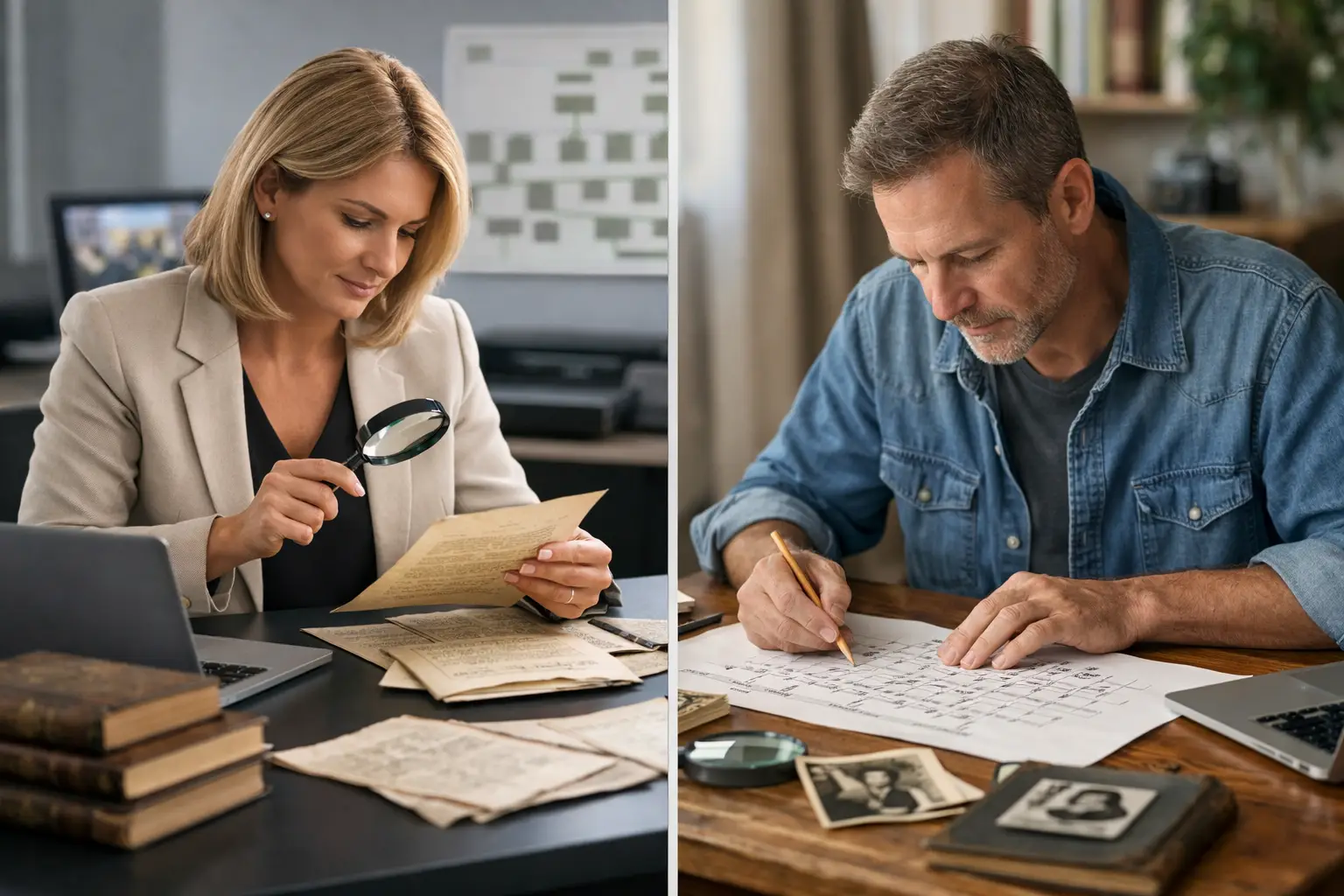
The difference becomes clearer when your goal is not simply building a tree, but identifying an exact ancestral place. A professional researcher with Slovenian experience understands how records were created and where they may be held. They can recognize historical place names, read common formats in parish records, and distinguish between neighboring villages that look identical in a family story.
This local knowledge matters because Slovenian family history is deeply tied to place. Your ancestor may have been baptized in one parish, married in another, lived in a hamlet outside a larger municipality, and been buried in a churchyard that still overlooks the family farm. Finding that chain requires more than a broad national search.
A professional can also assess evidence with necessary caution. It is tempting to accept the first person with a matching name and approximate birth year. Yet one incorrect connection can send a family tree down the wrong path for generations. An experienced researcher looks for corroborating details: parents’ names, house numbers, occupations, witnesses at a wedding, godparents at a baptism, and patterns of relatives traveling together.
Professional help does not mean handing over your family story and waiting passively. The strongest research is collaborative. You bring oral history, documents, family traditions, and questions. The researcher brings archival skill, language awareness, regional context, and a method for testing what the records actually support.
When researching on your own makes sense
DIY genealogy is often the right choice when you are still gathering the family’s basic information. If you have not yet organized what is in your own home, a professional cannot replace that first act of family listening. Start by recording what you know and noting where each fact came from.
It can also be a good fit if your goal is exploratory rather than urgent. Perhaps you enjoy learning research methods, are comfortable with incomplete answers, and want to spend months following one clue at a time. There is genuine value in that process. Each record can make your ancestors feel more real: a young couple signing a marriage register, a child’s baptism, a departure from a familiar village for an uncertain new life.
DIY work is especially useful for building a foundation before requesting expert assistance. A simple timeline of known relatives, copies of immigration and death records, and a list of family stories can make a later research project more focused and efficient.
When a professional researcher is worth it
Professional support becomes particularly valuable when the research has reached a wall. Perhaps every American record gives a different birthplace. Perhaps you have a village name but cannot tell whether it refers to the correct settlement. Perhaps the documents are in unfamiliar languages, handwritten in older styles, or available only through institutions in Slovenia.
It may also be the right choice when travel is part of your hope. A heritage journey feels very different when it is built around a well-supported ancestral connection. Rather than visiting Slovenia with only a surname and a general region, you may be able to visit the parish where your great-grandparents married, walk through their village, see the landscape that shaped their lives, or pause at a cemetery where family names still appear.
This is where research and travel belong together. A local expert can help turn records into a thoughtful route, while respecting the difference between documented fact and family possibility. Not every ancestral house will still stand, and not every family line can be traced to a precise address. But even a confirmed village, parish, or region can create a powerful sense of return.
For those planning a visit, Ancestry Slovenia approaches research as the beginning of a personal homecoming, not as a stack of documents left in a folder. The purpose is to help family history become a living experience in the country your ancestors once knew.
A practical middle path
For many families, the best answer is neither fully DIY nor fully outsourced. Begin with the records and stories closest to you, then seek professional help for the difficult transition into Slovenian sources. This approach keeps you connected to the discovery while giving the most complex questions the care they deserve.
Before contacting a researcher, gather copies rather than summaries whenever possible. A death certificate may contain details that were left out of a family tree. A passenger list may include a last residence or the name of a person left behind. Write down alternate spellings of surnames and places, even if they seem incorrect. What looks like an error may reflect how a Slovene name sounded to an English-speaking clerk.
Be clear about your goal as well. Do you want to identify a village? Confirm parents and grandparents? Understand why the family emigrated? Plan a trip around ancestral places? A focused question helps determine how much research is needed and what a meaningful result looks like.
Let the evidence lead you home
Genealogy asks for patience because family history rarely arrives in a neat line. A professional researcher can offer direction, context, and access, while DIY research preserves the intimate work of listening to your own family. The right choice depends on where your trail begins and where you hope it will lead.
If your family’s clues point toward Slovenia, keep them safe, write down the stories, and do not dismiss the details that seem ordinary. A village name remembered imperfectly, a patron saint, or an old photograph may be the thread that eventually leads you back to a place where your family story can be felt as well as known.