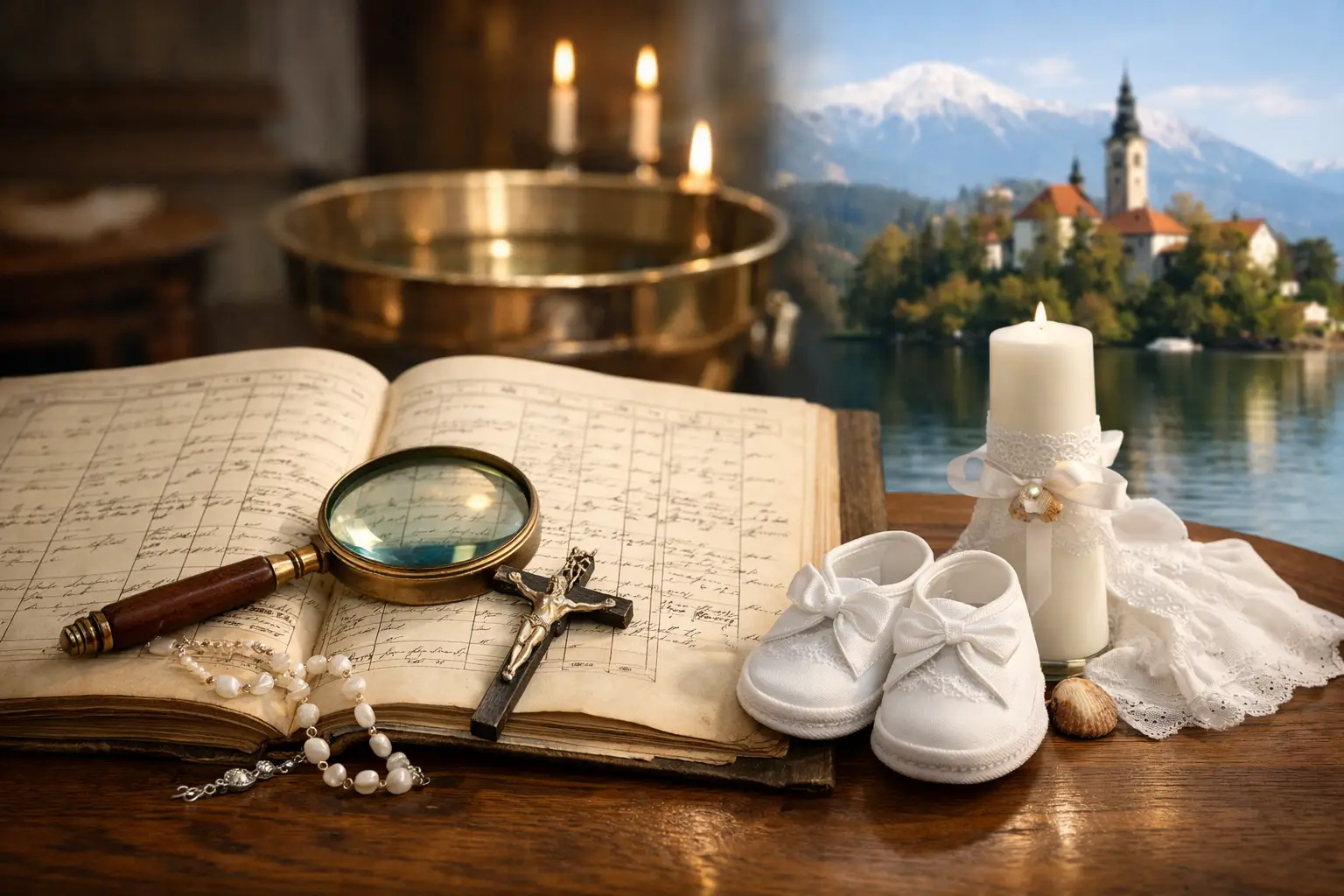
A baptism record can hold the name of the village your family left behind, yet the ink may look more like a row of waves than a word. Learning how to read old handwriting is often the moment when family history shifts from frustrating to deeply personal. One carefully deciphered surname, house number, or place name can lead you closer to the church, hillside, and community your ancestors once knew as home.
Old records are not meant to be read like modern printed text. They were written quickly, often by priests, clerks, or civil officials who assumed everyone around them could recognize the local names and writing conventions. With patience and a method, those unfamiliar marks begin to reveal the people behind them.
Why old Slovenian records can be difficult to read
For descendants researching Slovenian roots, the challenge is rarely handwriting alone. Parish registers and civil records may be written in Latin, German, Italian, Slovene, or a mixture of these languages, depending on the time period and region. The same ancestor may appear under several versions of a name. Johann, Janez, Ivan, and Joannes can refer to the same man.
Spelling was also flexible. A surname might be recorded differently by two priests, or altered after an ancestor emigrated to America. Letters such as K, G, H, and J can be particularly confusing, while capital letters may look entirely unlike their modern forms. Add faded ink, water damage, cramped margins, and centuries-old paper, and it is easy to feel stuck.
Still, these records follow patterns. Once you learn to recognize those patterns, you do not need to read every word at once. You only need to find the clues that connect one generation to the next.
How to read old handwriting one word at a time
The most useful rule is simple: do not begin by trying to read the whole record. Start with information you already know. If you believe the entry concerns your great-grandmother, look first for her approximate birth year, the parish name, a familiar surname, or the names of parents found in later documents.
Then compare letters within the same page. A priest may write a difficult capital letter only once in a name, but use the same lowercase letter many times in common words. If you cannot tell whether a surname begins with P, B, or R, find other words containing those letters and compare their strokes. This is often more reliable than guessing from the shape alone.
Read slowly and transcribe exactly what you see before deciding what it means. A question mark is more valuable than a confident but incorrect interpretation. Write down uncertain letters as blanks or use brackets, such as “K?vač.” Return to the word after reading nearby entries. Context has a remarkable way of clarifying what first looked impossible.
Read the structure before the script
Church and civil registers are usually organized around a repeated formula. Baptism entries may include the child’s name, date of birth, baptism date, parents, residence or house number, legitimacy, and godparents. Marriage records commonly identify the bride and groom, their parents, ages, occupations, and places of origin. Burial records may note age, cause of death, marital status, and residence.
Before deciphering every line, identify the columns or labels. If a word sits in the father’s-name column, it is probably not a village. If a number appears beside a household reference, it may be the family’s house number rather than an age. These details matter in Slovenia, where several unrelated families could share a surname within one parish.
A repeated record format also gives you a small vocabulary to expect. In a baptism book, you may repeatedly see words for father, mother, legitimate, farmer, widow, or village. Once these familiar terms become recognizable, your attention can settle on the unique details: the names and places that belong to your family.
Work from the clearest examples
Do not spend an hour on the darkest, most damaged entry first. Find a page written by the same hand where the ink is clearer, or look for a later record with more legible writing. Priests often had distinctive letter forms, flourishes, and abbreviations. A clear marriage entry from 1885 may help you understand a less readable baptism entry from 1872.
It also helps to study several records for the same family. A child’s baptism may confirm the spelling of a mother’s maiden name that is difficult to read in a marriage record. A burial entry may provide an age that supports a birth estimate. Genealogy becomes more reliable when each document is allowed to support the others.
Pay close attention to names, places, and house numbers
For heritage research, the most valuable words are not always the most obvious ones. A surname alone may not identify the right family. Many Slovenian surnames occur in multiple regions, and immigration records may list only “Austria,” “Yugoslavia,” or a broad province rather than a precise hometown.
A village name, parish, hamlet, or house number can be the detail that changes everything. House numbers were often assigned to properties rather than individuals, so they can help distinguish between families with the same name living in the same community. If you see “No. 12” in a baptism record, look for that number again in siblings’ records, parents’ marriage entry, and later death records.
Place names require care because historical records may use German, Italian, Latinized, or older Slovene forms. Borders and administrative districts changed over time, but the local landscape remained. A place name that seems unfamiliar may be a historical spelling of the village you are seeking, not evidence that you have found the wrong family.
When you make a transcription, preserve the original version of the name and record a modern interpretation separately. For example, note the spelling exactly as written, then add the likely modern village name in your research notes. This protects the evidence while making it easier to follow your family’s path.
Use language clues without letting them mislead you
You do not need to be fluent in Latin, German, Italian, or Slovene to make progress. Learn a small set of record words connected to relationships, dates, places, and occupations. Terms such as son, daughter, husband, wife, widow, born, died, legitimate, and unmarried appear again and again.
Names are often translated rather than simply misspelled. A woman known to her American grandchildren as Mary may be listed as Marija, Maria, or Marianna. A man remembered as Joseph could appear as Jožef, Josef, or Josephus. Do not reject a record only because the familiar American form is absent.
At the same time, avoid forcing a hoped-for answer. If the handwriting could read “Kranjc” or “Krajnc,” examine other records before choosing one. The right interpretation should fit the date, location, family relationships, and other known evidence. Good genealogy is built through careful connections, not a single exciting match.
Make a working transcription, not a perfect one
A useful transcription has two purposes: it captures what is on the page, and it makes your next research step clear. Include the record type, parish or locality, date, all names as written, house number, witnesses or godparents, and any uncertainty. Keep an image reference with your notes so you can revisit the original when new evidence appears.
For especially challenging pages, a practical workflow is to create three lines: the original text as best you can read it, a letter-by-letter transcription, and a plain-English interpretation. This prevents translation from hiding uncertainty in the handwriting. It also leaves a meaningful research trail for children, cousins, or future generations who may continue the work.
If you are preparing for an ancestry journey, bring these transcriptions with you. A partial village name, an old house number, or the names of godparents can be enough to guide local research and make a visit far more personal. Standing in an ancestral parish is different when you know the names that were written there at a baptismal font or in a marriage register.
When a second set of eyes matters
There is no shame in asking for help with difficult handwriting. In fact, it is often the wisest next step. A researcher familiar with Slovenian parish records can recognize regional place names, priestly abbreviations, historical language forms, and family naming patterns that are hard to spot from abroad.
This is especially valuable when one word could determine the next direction of your research: a birthplace, maiden name, father’s occupation, or residence. At Ancestry Slovenia, this kind of documentary detail can become the starting point for a more personal return – from a line in an old register to the village where your family story began.
The goal is not to defeat every faded word on your own. It is to listen carefully enough that the record can offer what it has carried for generations: a name, a place, and perhaps the first clear sign of the home your ancestors left behind.