A single baptism entry can change everything. A family story that says, “They came from somewhere near Ljubljana,” suddenly becomes a village name, a house number, and the names of grandparents you never knew. That is why learning how to use Slovenian parish records matters so much. For many families of Slovenian descent, these church books are the closest path back to the place where a family story truly begins.
Why Slovenian parish records matter so much
If your ancestors left Slovenia before modern civil registration became consistent and easy to access, parish records are often the core source for family history. In many areas, priests recorded baptisms, marriages, and burials long before government offices kept standardized vital records.
That makes parish books especially valuable for descendants in the United States, Canada, Argentina, and Australia who are trying to bridge a painful gap. You may know a surname, a rough date, or the fact that an ancestor was “Austrian” or “Yugoslav” on a census. Parish records can help translate that into the real local story – a specific parish, a specific village, and often a network of relatives who stayed nearby for generations.
They can also be humbling. These records are rich, but they are not always neat. Borders changed. Place names shifted between Slovene, German, Italian, and Latin forms. Handwriting can be hard to read. A record that looks obvious at first can turn out to belong to another family with the same surname in the next hamlet over. Good research in Slovenia is rarely about one lucky find. It is about fitting each clue into the right local context.
How to use Slovenian parish records without getting lost
The biggest mistake beginners make is starting with the record set instead of the place. Before you search for a baptism or marriage, you need to narrow down where your family likely came from.
That sounds simple, but for Slovenian descendants abroad, the place problem is often the hardest part. Old documents may name a region rather than a village. A ship manifest may use a German spelling. A death certificate in Cleveland or Pittsburgh may give a birthplace that was heard by an English-speaking clerk and written down phonetically. If you search parish records too soon, you can spend hours chasing the wrong parish.
Start with what your family carried forward. Gather naturalization papers, passenger lists, obituaries, gravestones, draft registrations, marriage licenses, and church records from the country where your ancestors settled. Pay special attention to sponsors, witnesses, and neighbors with the same hometown or surname. Slovenian immigrants often traveled and worshipped within community networks, and those networks can point back to the correct village.
Once you have a likely place, the next step is to identify the parish that served it. That part matters because the village name and the parish name are not always the same. A small settlement may have belonged to a larger neighboring parish, and that relationship may have changed over time.
What you will usually find in Slovenian parish books
Most people begin with three main types of entries: baptisms, marriages, and burials. Each offers different kinds of evidence.
Baptism records are often the most useful for proving parentage. They typically include the child’s name, baptism date, birth date if recorded separately, the father and mother, and often godparents. In many Slovenian communities, godparents were relatives or close neighbors, so those names can help distinguish between families with common surnames.
Marriage records can be especially revealing when you are trying to connect generations. A marriage entry may give the bride and groom’s ages, marital status, home parish, and fathers’ names. In some cases, it also tells you whether one party came from another village or parish, which is exactly the kind of clue that helps a research line move.
Burial records are less detailed in some periods, but they still matter. They can confirm age, residence, and timing, and they may explain why a child disappears from the family pattern or why a remarriage took place sooner than expected.
Some books contain more than these basics. You may see confirmations, status animarum or household censuses, notes about legitimacy, military service, migration, or later marriages written into a baptism entry. Those side notes are easy to overlook, but sometimes they hold the most human detail in the record.
Language, handwriting, and old place names
One reason people hesitate to work with these records is the fear of not knowing Slovene. That concern is understandable, but it should not stop you.
Older Slovenian parish records may appear in Latin, German, Slovene, or a mix of all three. Names can also shift form within the same family. A man baptized as Johann in one entry may appear as Janez or Ivan elsewhere, depending on the priest, the period, and the language of the book. Women’s names change too, and surnames may be spelled several ways without meaning the family changed at all.
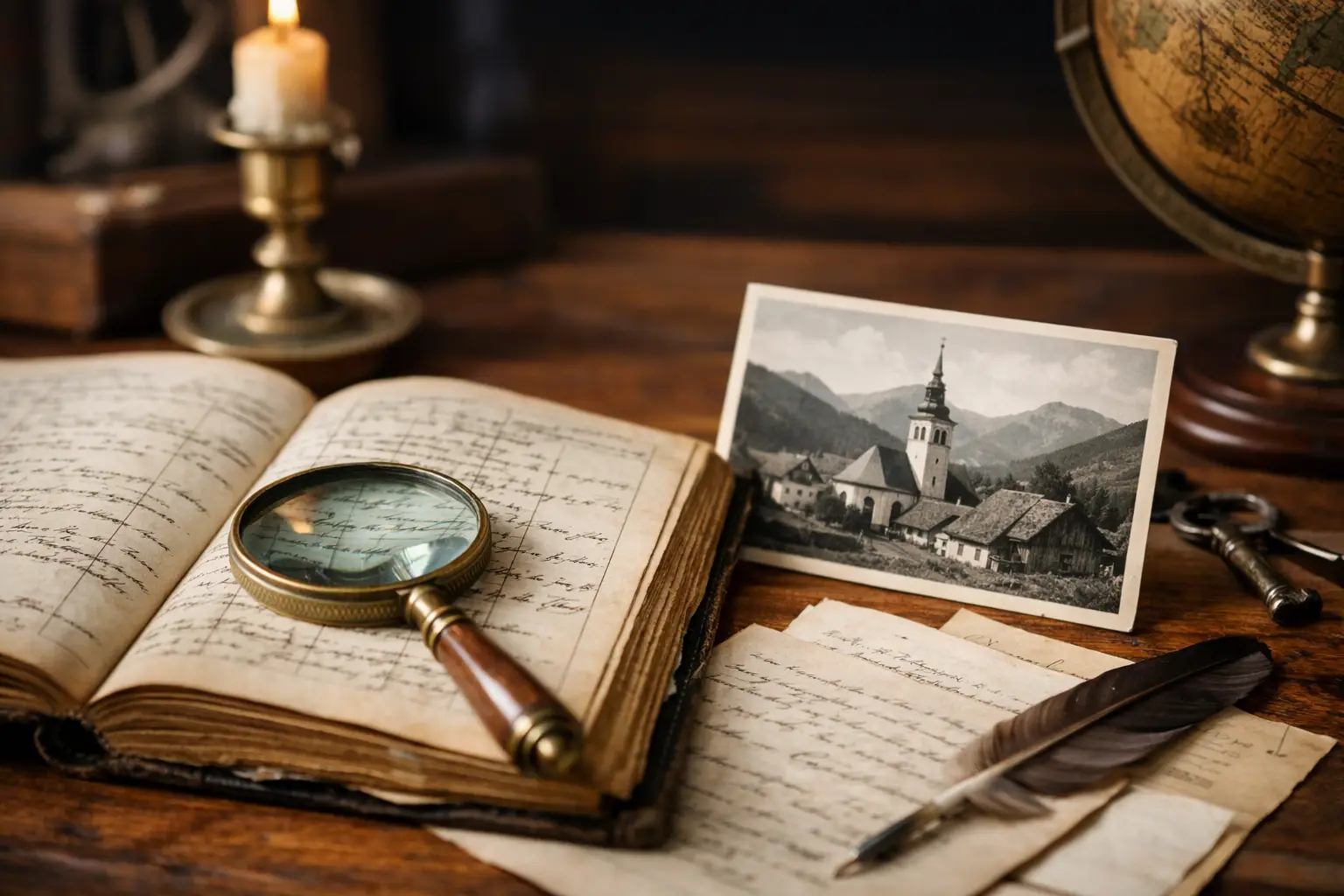
Handwriting is the other challenge. Nineteenth-century script can be difficult even for experienced researchers. The key is to avoid reading one word in isolation. Compare letters across the page. Study repeated column headings. Look at how the priest wrote the same surname in multiple entries. Patterns usually emerge once you stop treating the record like modern printed text.
This is also where local geography matters. Slovenian villages are close together, and many surnames repeat within a small area. If a place name looks unfamiliar, it may be an older version, a German equivalent, or the name of a hamlet rather than the municipality used today. Research becomes much easier when you map the family in relation to nearby villages, not just a single named town.
A practical way to work through a parish record search
If you are serious about how to use Slovenian parish records well, work from the known to the unknown. Begin with the most recent confirmed event for your ancestor and move backward one generation at a time.
Suppose you know your great-grandfather married in Ohio in 1908 and his death record says he was born in 1884. Look first for evidence of his birthplace in American records. If you find a village name or a likely parish, search for a baptism around 1884, but do not treat the first matching name as proof. Check whether the parents’ names fit later marriage or death records. Then look for siblings in the same parish. Families traveled as clusters in the records just as they did in life.
Once you identify the parents, search for their marriage before the oldest known child. Then move to their baptisms, and then to burials if dates suggest one parent died young. This step-by-step method is slower, but it prevents one of the most common mistakes in Slovenian genealogy: attaching yourself to the wrong family because the surname looked familiar.
It also helps to build a timeline, even a simple one. Record every date, village, parish, house number, occupation, and sponsor name. House numbers, in particular, can be powerful in Slovenian research because they tie families to a specific place across multiple entries. When the same surname appears in several households, the house number may be what tells the right family apart.
What to do when the trail goes cold
Sometimes the record is not where you expect it to be. The parish may have changed jurisdiction. The book may have a gap. The ancestor may have been born in the bride’s home parish even though the family later lived elsewhere. Or the name in America may have been shortened, translated, or altered enough that it no longer matches the original form cleanly.
When that happens, widen the circle carefully. Look at neighboring parishes. Search for siblings rather than the direct ancestor. Study marriage witnesses and baptism sponsors. In emigrant families, collateral relatives often leave the clearest trail home.
This is also the point where local expertise can save months of frustration. Slovenia is small, but its record landscape is highly local. Knowing which parish served which village, how a regional surname tends to appear, or when a certain book changes language is not a minor detail. It is often the difference between a guess and a documented family line. That is where a heritage-focused research partner such as Ancestry Slovenia can help turn scattered clues into a place you can actually stand in.
From record to return
Parish records do more than prove names and dates. They restore texture. They show who stood as godparents, which village lane a family lived on, and which parish church held the milestones of their lives. For descendants abroad, that can be the moment family history stops feeling abstract.
There is something deeply moving about reading a baptism or marriage entry and realizing your ancestors were not just “from Slovenia.” They belonged to a particular church, a particular hill village, a particular community that still exists. And once you know that, the journey changes. You are no longer searching in the dark. You are returning with direction.