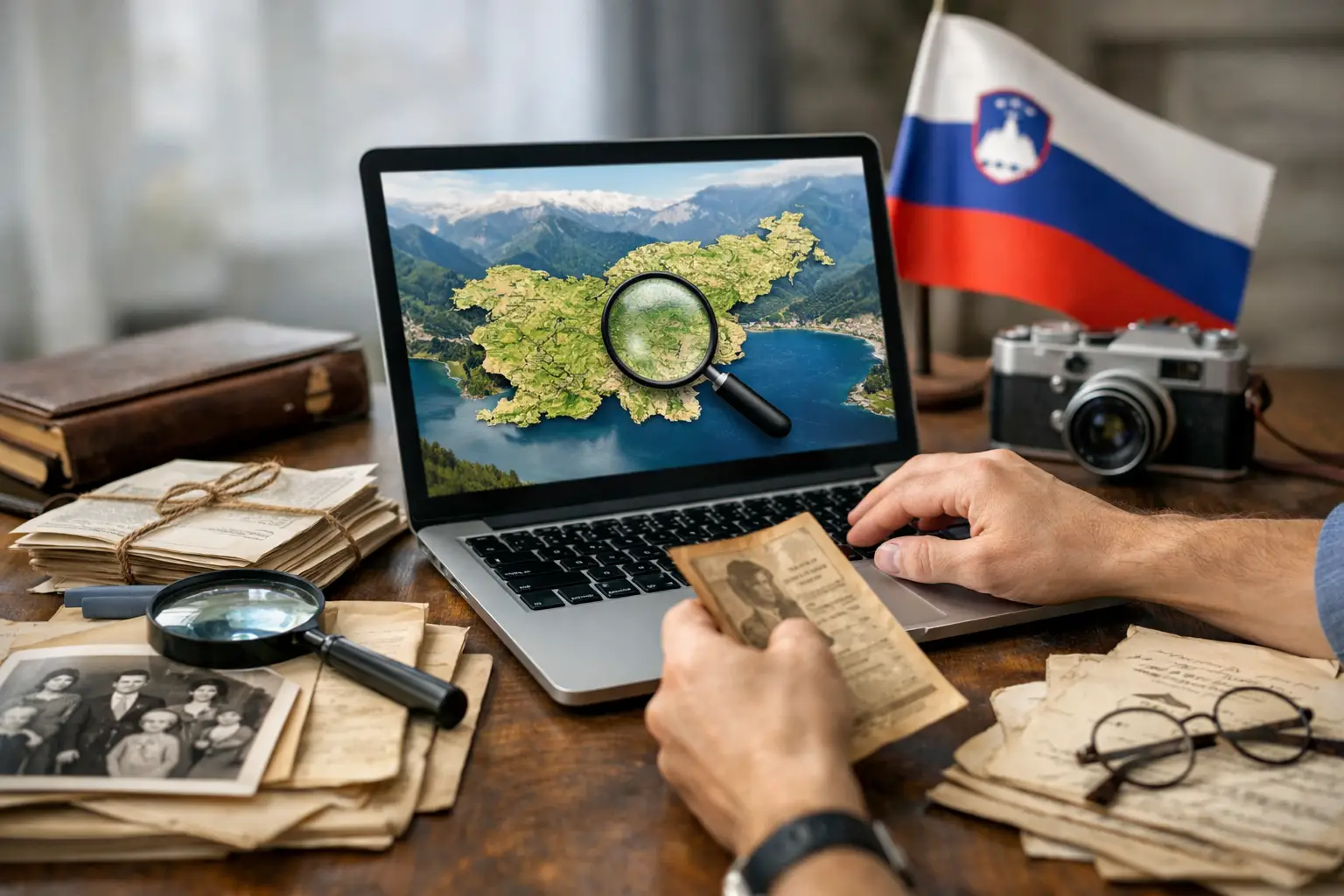

A successful slovenian immigration records search often begins with a small, imperfect clue – a misspelled surname on a ship manifest, a family story about Cleveland or Pittsburgh, or an old photograph labeled only “from home.” For many descendants of Slovenian immigrants, that first search is not just about dates and documents. It is the beginning of a return to the places your family once knew by heart.
What a Slovenian immigration records search can actually tell you
People often begin by looking for one record, usually a passenger list. Sometimes that works. More often, the real story appears only when several records are read together.
A Slovenian immigration records search can help you identify when your ancestor left Europe, where they arrived, who they were traveling to, what language they spoke, whether they were married or single, and, in the best cases, the exact town or parish they named as their birthplace. That last detail matters most. In Slovenian genealogy, finding the ancestral village is usually the turning point between broad family history and truly personal discovery.
There is one complication that surprises many families. Your ancestors may not have listed “Slovenia” at all. Before 1918, most Slovenian emigrants left from the Austro-Hungarian Empire. Later records may say Yugoslavia. Some people identified by region, language, province, or empire rather than the modern nation we use today. That means a search needs patience and context, not just a quick name lookup.
Why these records can be hard to find
Immigration research is rarely neat. Slovenian surnames were often altered by clerks, simplified after arrival, or Americanized by families trying to fit into a new life. A name ending in -ic, -ec, -nik, or -šek might appear in several different spellings across records. Even given names shift. Janez may become John, Jožef may appear as Joseph, and Marija may be recorded as Mary.
The bigger challenge is geography. Modern Slovenia is small, but historical jurisdictions were layered. The same family could appear in civil records, parish registers, military documents, and emigration paperwork under different place descriptions. A village may be written in Slovene, German, Italian, or an older regional form. If your ancestor came from Primorska, Lower Carniola, Styria, or Prekmurje, the historical context can change which records you need and how the place is named.
That is why a good search is less about one database and more about building a case from many clues.
How to begin a Slovenian immigration records search
Start with the family papers closest to home. Naturalization certificates, death records, obituaries, church marriage records, tombstones, military draft cards, and old passports can all contain birthplace clues. Even an address book, prayer card, or funeral notice may preserve a village name that never made it into a formal family tree.
Then move outward to US and overseas records in layers. Passenger arrival lists can provide age, occupation, last residence, nearest relative in Europe, and destination in America. Naturalization records can help confirm arrival dates and sometimes include more precise birthplace information than later census records. Census entries are useful too, though they are not always consistent. They often help establish immigration year ranges and household relationships.
If your ancestor arrived in the early 20th century, pay close attention to manifests that ask for both the last permanent residence and the name of a relative or friend in the old country. Those two lines can be more valuable than the entire rest of the page.
The records that matter most
Passenger lists and arrival manifests
For many families, this is the emotional first discovery. Seeing an ancestor’s name on a passenger list makes the migration story feel real. But these records are most useful when you read every column carefully. A village of origin may be tucked into a line you almost skip.
Naturalization files
Naturalization records can bridge the old country and the new one. Declarations of intention, petitions, and certificates may include the date and port of arrival, former nationality, and sometimes the exact birthplace. Earlier records can be sparse, while later ones are often richer.
Census and church records in the destination country
US census records may not name a town in Slovenia, but they can reveal immigration year, citizenship status, language spoken, and family structure. Church records in immigrant communities are sometimes even better. Slovenian parishes abroad often preserved original names more faithfully than civil officials did.
Draft registrations, obituaries, and death certificates
These records are often overlooked. A draft card may show a birth date that helps separate two men with the same name. An obituary may mention a hometown or region. A death certificate may name parents, though the quality depends on who supplied the information.
When the record says Austria or Yugoslavia
This is one of the most common moments of confusion. If a record says Austria, it does not rule out Slovenian origin. It may simply reflect the political reality at the time your ancestor emigrated. The same is true for Yugoslavia in later periods.
What matters is learning to read historical identity alongside modern geography. A town now in Slovenia may once have been recorded under an Austrian crown land, a German place name, or a broader state identity. This is where families often feel stuck, especially if they are trying to match an unfamiliar place name from an old manifest to a modern map.
Sometimes the key is not the country field at all. It is the birthplace, the nearest relative, the ethnic parish in America, or the cluster of people who traveled together from the same area.
How village-of-origin research changes everything
Once you identify the ancestral village, your family history stops being abstract. You can begin to trace baptisms, marriages, burials, house numbers, land patterns, and kinship networks. You may learn that several branches lived within walking distance of one another, or that a family left after crop failures, factory work opportunities abroad, or military pressures shaped their choices.
For descendants, this is often the most moving stage of the journey. A village name is not just a data point. It is the doorway to parish books, cemetery visits, local archives, and a place you can actually stand in. This is where genealogy becomes personal geography.
A careful Slovenian immigration records search is often what opens that door.
Common mistakes that slow families down
The first is assuming spelling must be exact. It rarely is. Search broadly, try phonetic variations, and stay open to shifted endings and translated first names.
The second is trusting one record too much. An ancestor may list different ages, arrival years, or birthplaces over time. That does not mean the trail is wrong. It means the records need to be compared rather than taken at face value.
The third is stopping at the port record. Immigration documents are only part of the story. The real breakthrough often comes from combining arrival records with naturalization papers, church records, family correspondence, and local Slovenian sources.
When to get help from a Slovenia-based expert
There comes a point when online searching reaches its limit. If the place name is hard to decipher, if the village changed jurisdictions, or if multiple families share the same surname, local knowledge becomes incredibly valuable. The difference between one parish and the next can change the entire direction of research.
This is especially true when your goal is not only to identify ancestors, but to reconnect with the place they left behind. At that stage, research and travel begin to meet. A document found abroad can lead to a church in a hillside village, a cemetery inscription, a farmhouse location, or a local archive holding the next chapter of your family story.
That is the work we care deeply about at Ancestry Slovenia – helping descendants move from uncertain clues to real places, and from records on paper to a meaningful experience of homecoming.
The deeper value of the search
Many people begin this process because a grandparent is gone, family stories are fading, or younger generations are asking questions no one can fully answer. Immigration records will not tell you everything. They will not capture every feeling, sacrifice, or hope that shaped the journey.
But they can give you something lasting. They can name the place your family came from. They can restore original identities that were blurred over time. They can help you preserve a story that might otherwise disappear within another generation.
And sometimes, with enough care, they can do something even more powerful. They can bring you back to the village where your family’s story in Slovenia still quietly waits.