You may know only a surname, a faded wedding photo, or the story that your grandfather came from “somewhere near Ljubljana.” That is often enough to begin. A beginner guide to Slovenian genealogy does not start in an archive. It starts at the family table, with the fragments that survived migration, language changes, and time.
For many descendants abroad, researching Slovenian roots is about more than building a family tree. It is about returning names to real places, understanding why a family left, and finding the church, village, or hillside cemetery that once shaped their daily life. The process can be deeply moving, but it also helps to approach it with a clear method.
A beginner guide to Slovenian genealogy starts with home sources
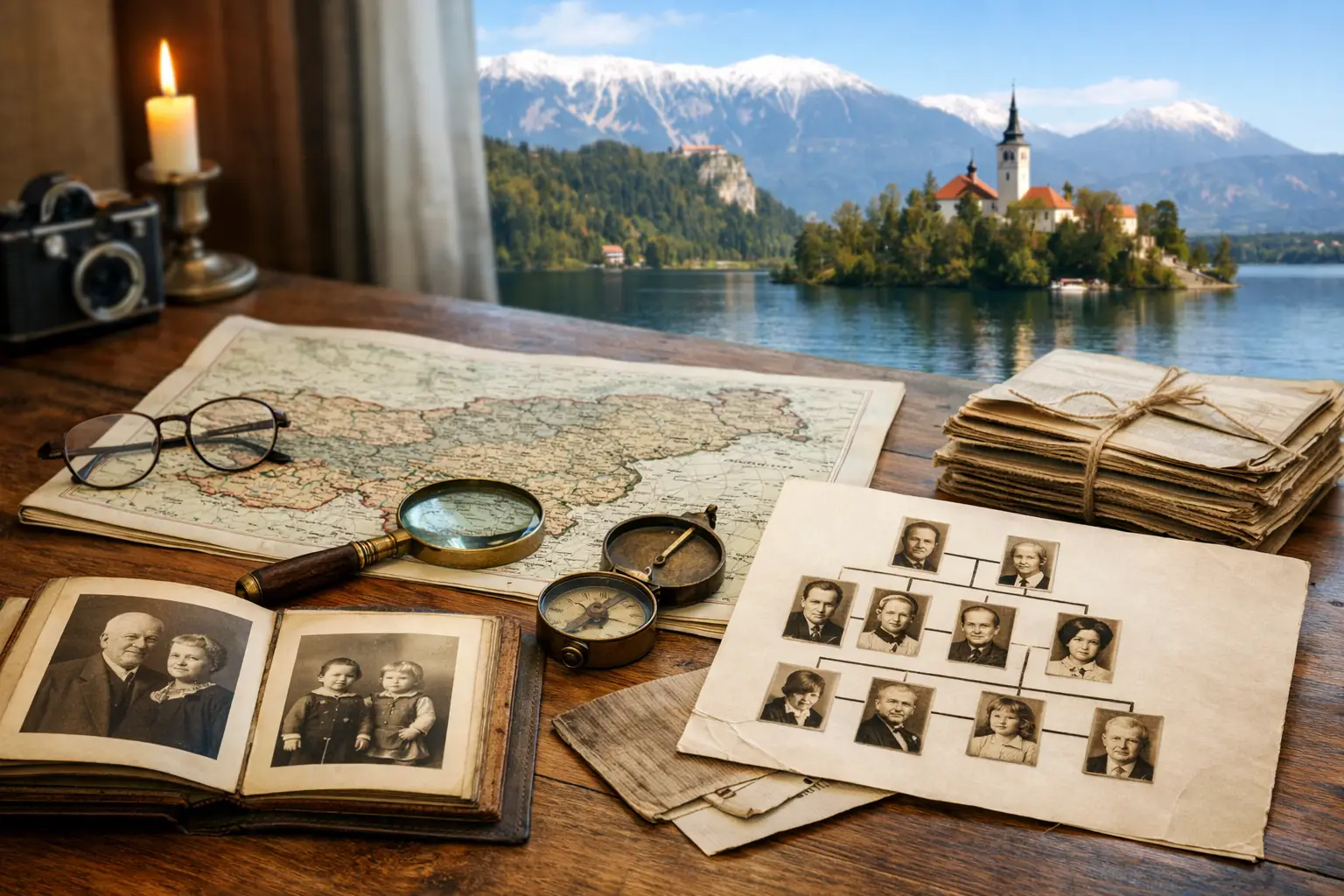
Before you search any formal record, gather everything your family already holds. Old passports, memorial cards, naturalization papers, military documents, ship manifests, letters, prayer books, and inscriptions on the back of photographs can all carry the clue that matters most – a village name.
That village matters because Slovenian genealogy is place-based. Many surnames appear in multiple regions, and historical records were often kept at the parish or local civil level, not in one easy national file. If you know only that an ancestor was “Slovenian,” you still have a broad starting point. If you can narrow it to a town, parish, or former province, your research becomes far more precise.
Talk to the oldest relatives first, even if they think they do not know much. Ask where the family said they came from, what language they spoke at home, whether they mentioned saints’ days or feast traditions, and whether they used German, Italian, or Slovenian versions of their names. Slovenia’s history includes shifting borders and administrations, so one ancestor might appear under different place names depending on the record and the year.
What makes Slovenian family research different
A good beginner guide to Slovenian genealogy should prepare you for one basic truth: records may exist, but names and jurisdictions may not look the way you expect. Present-day Slovenia is small, yet its historical records reflect the Habsburg Empire, Austro-Hungarian administration, local parishes, and border changes affecting nearby regions.
That means your ancestor may have identified with a village that is now in Slovenia, while an older record lists the place in German or Italian. A surname may also shift spelling after arrival in the United States, Canada, Argentina, or Australia. Novak might remain Novak, but other names were shortened, translated, or written phonetically by officials who heard them once and guessed.
This is where patience matters. Genealogy is not only about finding a matching name. It is about matching a person to a place, a date, a family network, and a migration story. If one detail seems off but three others align, you may still be on the right path.
The records most beginners should search first
If your family emigrated to the United States, start with records created after arrival and work backward. Passenger lists, census records, death certificates, obituaries, Social Security applications, naturalization papers, and church sacramental records often preserve the last usable clue from the old country.
Naturalization files are especially valuable because they may name a town of birth or former residence. Death certificates and obituaries can help too, although the information depends on who reported it. A grieving spouse or child may have guessed at details, so treat those records as leads rather than final proof.
Once you identify a likely town or parish, church records become central. In Slovenian research, parish registers often carry baptisms, marriages, and burials across generations. Civil registration can also help, especially in later periods, but parish records are often where family lines become visible. When you find one confirmed entry, you can often begin reconstructing siblings, godparents, and neighboring households.
Focus on the ancestral village, not just the surname
Many beginners lose time by chasing every family with the same last name. It feels logical, but it can quickly lead to the wrong branch. In Slovenia, village identity is often the stronger anchor.
If you can identify the village of origin, even approximately, your research becomes more grounded. You can compare parish boundaries, nearby settlements, migration routes, and naming patterns. You can also begin to understand the world your ancestors knew – whether they lived in an Alpine valley, a wine-growing region, a farming village, or an industrial town.
That context is not a sentimental extra. It often explains why a family emigrated and where they settled abroad. A mining family may have followed labor routes. A rural household may have sent one son overseas while others remained. Seeing the village in relation to economy, religion, and geography often makes the paper trail more coherent.
Expect language and spelling challenges
One of the first surprises for descendants abroad is how many versions of the same name may appear across records. Given names often shift between Slovenian, German, Latin, and English forms. Jozef may appear as Joseph. Marija may become Mary. Franc can become Franz or Frank.
Place names can be even trickier. A village may appear with a historical German exonym in one record and its Slovenian name in another. Handwriting adds another layer. Parish books were not written for modern researchers, and reading them takes practice.
This does not mean you need to become a linguist before you begin. It means you should stay open to variation and avoid ruling records out too quickly. If the age, family members, religion, and place line up, a spelling difference may be minor.
When to seek help with Slovenian genealogy
Some family lines open quickly. Others stall for reasons that are common in Slovenian research: missing village names, illegible handwriting, duplicate surnames, border-era records, or uncertainty about the correct parish. At that point, local knowledge can make a significant difference.
A Slovenia-focused researcher can often recognize regional naming patterns, historical jurisdictions, and local record systems that are easy to miss from abroad. More importantly, they can help connect documentary evidence to physical place. That is often the turning point, when genealogy stops feeling abstract and begins to feel personal.
For many families, the most meaningful moment is not finding a name in a register. It is standing in the village where that name belonged. It is seeing how close the church was to the family home, walking the road an ancestor likely knew, or understanding the landscape they left behind. That is where research becomes reconnection.
Turning research into a roots journey
Once you have a village, parish, or cluster of family locations, travel takes on a different meaning. You are no longer planning a general trip to Slovenia. You are preparing to visit your family’s Slovenia.
This is where careful planning matters. A heritage trip works best when it is guided by research rather than guesswork. If you know where baptisms took place, where marriages were recorded, and where family graves may be located, each stop has emotional weight. You are not trying to see everything. You are trying to see what belongs to your story.
For descendants who live far away, this can be the moment when generations reconnect. Adult children begin asking questions. Grandchildren understand that the family history they heard at holidays has a real setting. A village that once sounded distant becomes part of the family’s living memory again.
At Ancestry Slovenia, that bridge between records and place is at the heart of the journey. The goal is not simply to confirm names on paper, but to help families return to the exact communities that shaped them.
Start simple, then go deeper
If you are just beginning, do not wait for perfect information. Start with one family line, one immigrant ancestor, and one question you want answered. Where were they born? What was the village? Which parish served that place? Why did they leave?
You may find answers quickly, or you may need time to sort through conflicting records. Both experiences are normal. Genealogy rarely moves in a straight line, and Slovenian family history often asks for persistence. But every clear detail you gather makes the next step more possible.
Family history has a way of meeting people at the right time. Sometimes it begins with curiosity. Sometimes it begins with loss, with the wish to preserve what older relatives knew before it disappears. However it starts, the search can lead you home in ways that are both practical and deeply personal.
If your family story begins with a name that crossed an ocean, there is still a good chance it leads back to a real Slovenian place, waiting to be recognized. Start there, gently and carefully, and let the trail become a return.