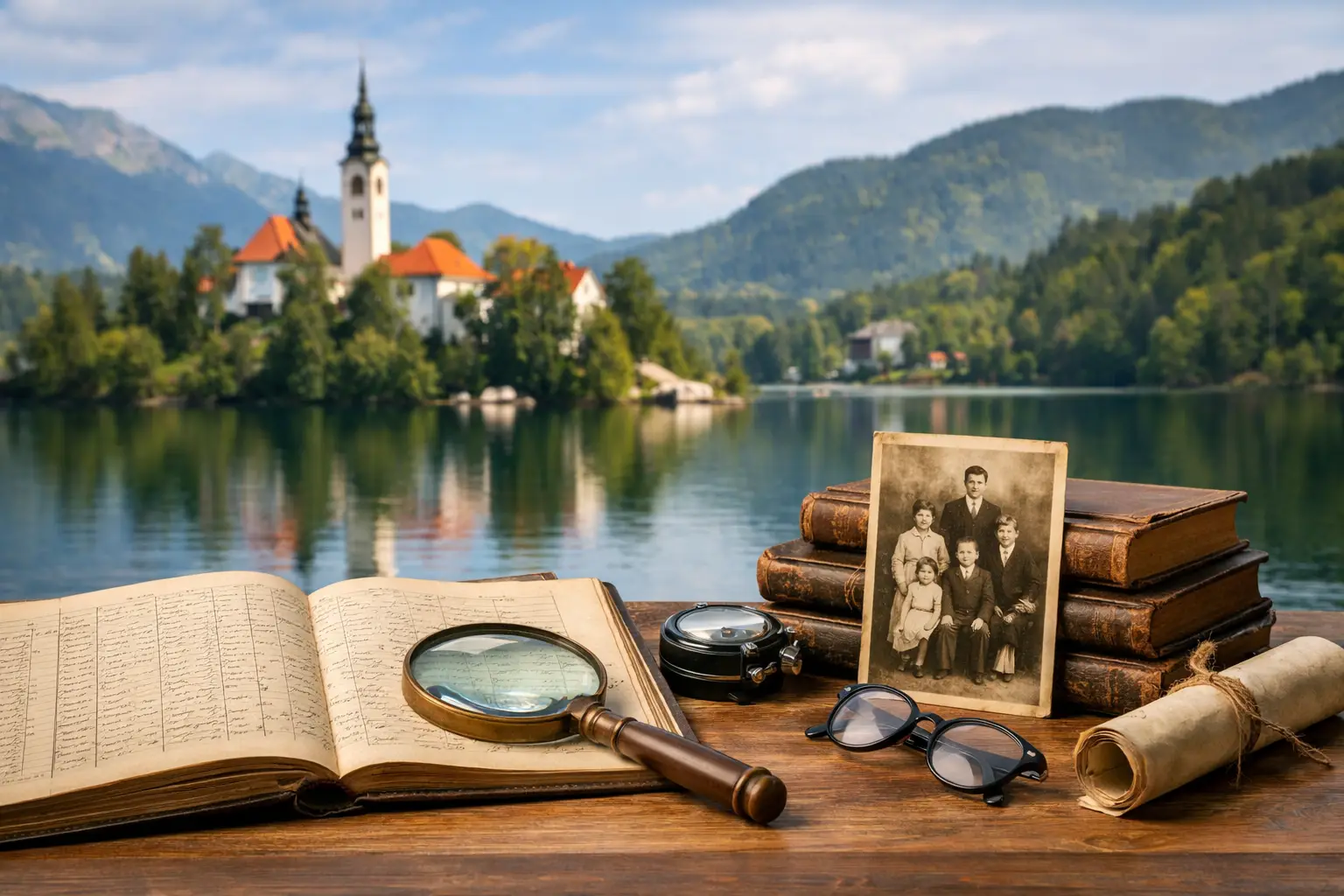
A baptism entry from a small Slovenian parish can do more than confirm a date. It can name the village your great-grandmother came from, identify her parents, and place your family inside a real community rather than a vague story about “the old country.” That is why slovenian church records genealogy is often the turning point for descendants trying to reconnect with family roots.
For many families in the United States, Canada, Argentina, or Australia, the paper trail grows thin the moment an ancestor crossed the ocean. Passenger lists may give a surname. Naturalization papers may offer a birthplace that is misspelled, incomplete, or recorded under an old empire. Church records from Slovenia often fill in what emigration records leave out. They are some of the most meaningful sources for identifying where a family lived, worshipped, married, and was buried.
Why Slovenian church records genealogy matters so much
In Slovenian family history research, parish registers are not just supporting documents. In many cases, they are the core record set. Before widespread civil registration, local Catholic parishes and other religious communities recorded baptisms, marriages, and burials with remarkable consistency. Those records can stretch back centuries, depending on the parish and preservation history.
This matters because most descendants do not begin with a neat archive reference. They begin with fragments – a surname, a rumor about a village, maybe a prayer card or an old funeral notice. Church records can connect those fragments into a family line. A baptism record may reveal house numbers, godparents, and mother’s maiden name. A marriage record may link two villages and two family networks. A burial record may help distinguish between people with the same given name.
There is also an emotional side to this work. When a record names the church where your ancestors were baptized or married, family history stops feeling abstract. It becomes tied to a hillside parish, a cemetery path, a village bell tower. For many people, that is the moment research begins to feel like returning home.
What you can usually find in Slovenian parish records
The most common records used in Slovenian genealogy are baptism, marriage, and burial registers. Depending on the time period and the parish, confirmation records, status animarum or family books, and indexes may also survive. Some books are neat and detailed. Others are faded, damaged, or written by several priests over many decades.
Baptism records are often the richest starting point. They may include the child’s name, date of birth and baptism, parents’ names, mother’s maiden surname, legitimacy status, godparents, residence, and sometimes a house number. That house number can be incredibly useful in a village where the same surnames appear again and again.
Marriage records often provide the names of the bride and groom, their ages, marital status, residence, and parents’ names. They can also note whether a person was from another parish, which is helpful when an ancestor did not marry in the village where they were born.
Burial records may seem less exciting at first, but they are often what clarifies identity. If several men in one parish share the same name, death entries can separate generations and connect spouses correctly. They also help estimate birth years when baptism entries are still missing.
The language and handwriting challenge
One reason slovenian church records genealogy can feel intimidating is that the records are rarely in modern English and not always in modern Slovenian either. Depending on the period, you may see Latin, German, Slovenian, or a mix of all three. Place names may appear in older forms, and surnames may be spelled differently from one record to the next.
Handwriting adds another layer. Nineteenth-century script can be hard to read even when the page is clear. Priests used abbreviations, local naming habits, and spelling conventions that changed over time. A surname you know as Novak might appear in slightly different forms. A village may be listed under a historical name used during the Habsburg period.
This does not mean the records are unusable. It means context matters. If you know the approximate religion, county, village region, and family naming patterns, a difficult entry becomes much easier to interpret. Without that context, it is easy to chase the wrong person.
How to start if you only know a surname
Many descendants worry that they do not know enough to begin. In truth, most family searches start with incomplete information. If you only know a surname and a story that your family came from Slovenia, begin by collecting every clue already in the family.
Look closely at US records first. Death certificates, obituaries, marriage licenses, church registers in immigrant neighborhoods, naturalization files, old passports, gravestones, and family letters may all contain a birthplace clue. Sometimes the detail is hidden in plain sight. A village is written on the back of a photograph. A sponsor at a baptism shares the same surname as a known relative. A church marriage entry in Cleveland or Chicago names the parish back in Slovenia.
Once you have even a partial place name, Slovenian parish research becomes far more targeted. The real challenge is not usually finding a church book. It is identifying the correct parish and village before you start reading one.
Finding the right parish is often the real breakthrough
Slovenia is small, but surnames repeat across regions, and village names can be similar. Boundaries also changed over time. An ancestor who said they were from Austria, Carniola, Styria, Yugoslavia, or Slovenia may have come from the same exact place under different political names.
That is why locating the ancestral village matters so much. Church records were kept at the parish level, not according to modern family-tree expectations. If you search the wrong parish, you may conclude the record does not exist when it is simply recorded a few miles away. Villages could belong to one parish for baptisms and have marriage connections in another. It depends on local history, geography, and the period.
For descendants planning a heritage trip, this is where research and travel naturally meet. When you can identify the village and parish, you are no longer visiting Slovenia as a tourist passing through. You are standing where your family marked the milestones of life.
What can complicate the search
Not every family line is straightforward. Records may be missing, damaged, or inaccessible for a certain period. Some books have gaps. Some priests recorded more detail than others. Border regions can introduce shifting languages and jurisdictions. Families moved for work, remarriage, or land, so one generation may appear in several neighboring parishes.
There is also the issue of religious background. Many Slovenian records are Catholic, but not all Slovenian families were. Lutheran and other communities kept records too, though survival and access can differ by location. If family tradition points to a different denomination, that should shape the research strategy from the start.
Names can also mislead. Americanized first names and altered surnames are common in immigrant communities. A man remembered in the family as John may appear as Johann, Ivan, or Joannes depending on the place and language of the record. The right match often comes from a cluster of details rather than one perfect name.
Turning records into a real family journey
A church record is powerful on its own, but its meaning deepens when placed back into the landscape of Slovenia. The parish register tells you a child was baptized in a certain church. Visiting that church, seeing the village road, and understanding the region where the family lived turns that fact into something lived and felt.
This is where many descendants experience a shift. Research begins as a search for names and dates, then becomes a way to understand inheritance, migration, faith, and belonging. You begin to see why a family left, what community shaped them, and what still connects you to that place today.
For families who want both the documents and the experience, a guided approach can save enormous time and uncertainty. Ancestry Slovenia helps bridge that gap by combining village-of-origin research with meaningful travel planning, so the records you uncover can lead you back to the exact places your ancestors once knew.
Slovenian church records genealogy as a starting point, not the end
The most valuable thing about parish research is that it rarely answers only one question. One baptism leads to a marriage. One marriage reveals a maiden name. One burial points to another generation. Soon the family line begins to take shape not as isolated individuals, but as a network of houses, villages, and relationships across time.
And even when the trail is not simple, the search is still worth it. A partial answer can still reconnect a family to a region, a church, or a community memory that had nearly disappeared. If your Slovenian roots have long felt just out of reach, church records may be the quiet, handwritten path that brings them back into view.