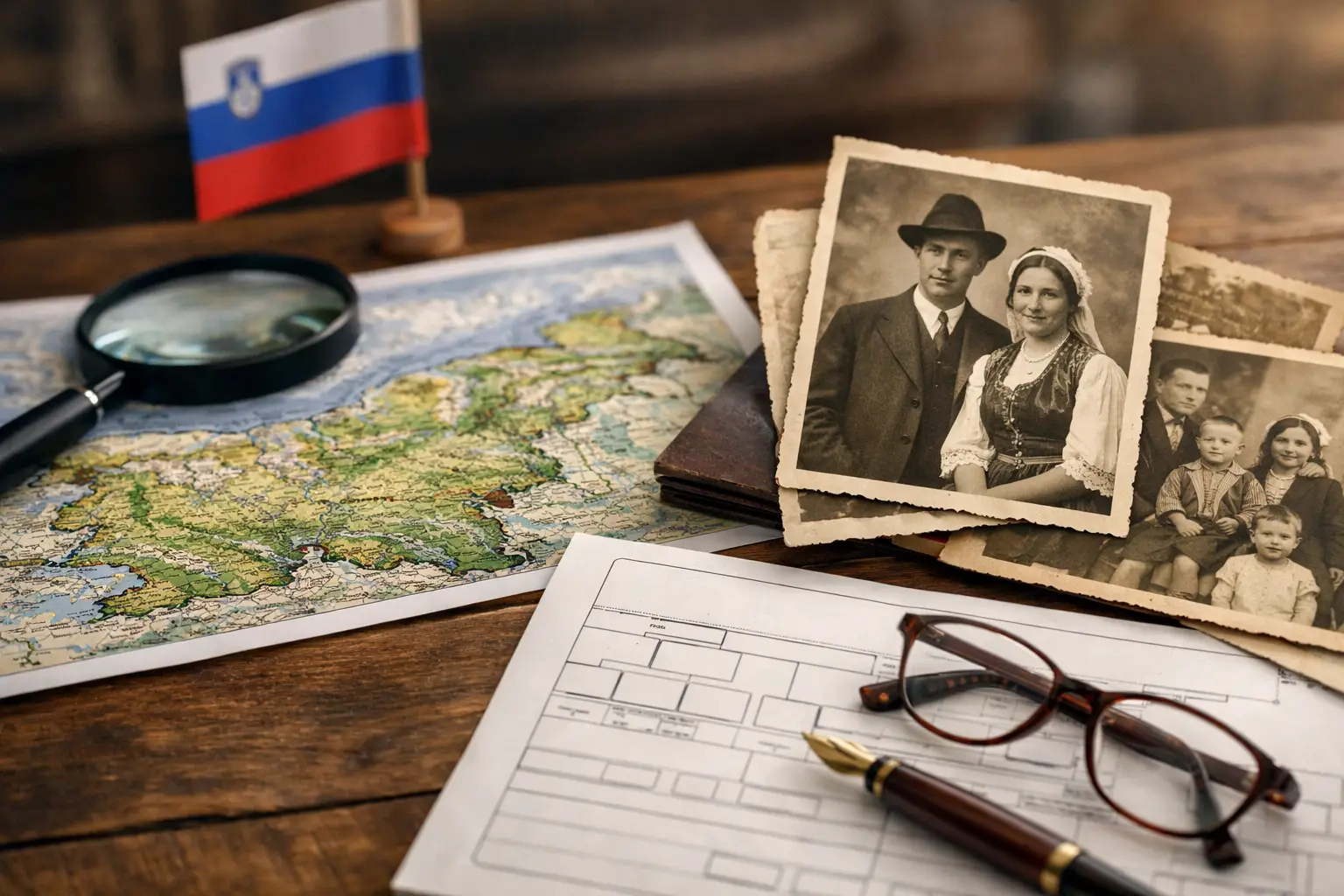
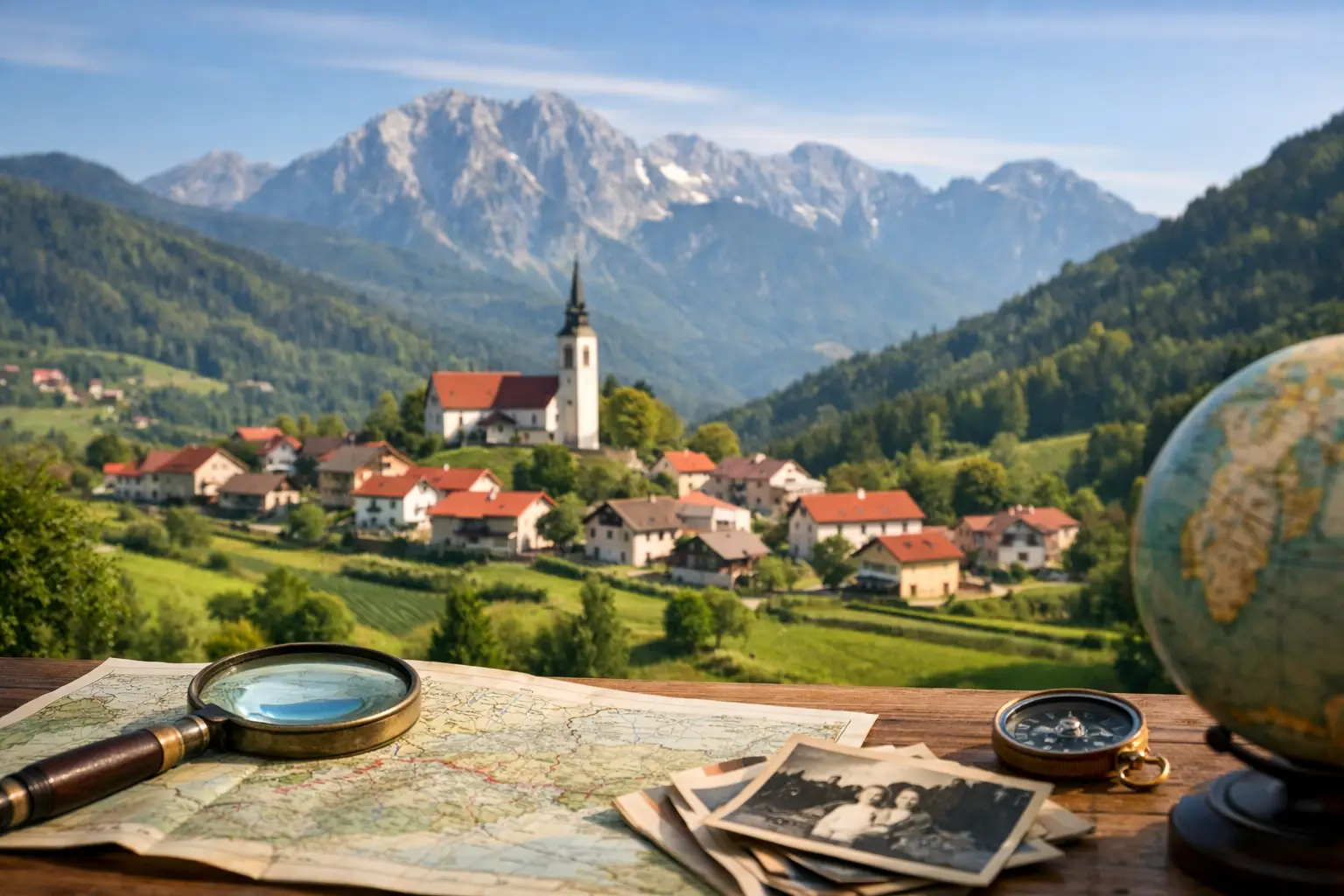

A faded obituary may say only “Slovenia.” A passenger list may name Austria, Yugoslavia, or a town spelled in a way no modern map recognizes. Yet behind that single, frustrating clue may be a particular hillside village, a parish church, a family farm, and relatives who knew your ancestors by a Slovenian name that changed when they crossed an ocean.
Learning how to identify ancestral village Slovenia is rarely a matter of one perfect record. It is a process of bringing small pieces together until the place becomes clear. For Slovenian descendants, that work can turn a family story into something wonderfully specific: not simply that your great-grandmother came from Slovenia, but that she was baptized in a certain parish, married in a nearby town, and grew up in a village you can still walk through today.
Begin With the Records Closest to Home
The best clue is often not in Slovenia at all. Start with the records created after your ancestor emigrated, especially those that captured information before memories faded or names became more Americanized.
A death certificate, obituary, naturalization petition, church marriage record, or passenger manifest may name a birthplace. Family Bibles, old letters, prayer cards, photographs, and funeral cards can be equally valuable. Ask relatives for the details they may assume are unimportant: a pronunciation, a patron saint, the name of a cousin, or a memory of “the old country.” These fragments often become the thread that leads to a village.
Be careful with broad place names. An ancestor who said they were from “Austria” may still have been Slovenian. Much of present-day Slovenia belonged to the Habsburg Empire before 1918, and later records may list Yugoslavia instead. Someone born near the western border might be described as Italian, while a record from the northeast may use a Hungarian place name. The political label on a document tells you the historical setting, but it does not necessarily identify the village.
Write down every version of the place name exactly as it appears, including misspellings. A name that seems wrong may be a phonetic attempt by an English-speaking clerk to record a Slovenian village name.
Separate the Village From the Parish and District
One common obstacle is assuming every place named in a record is the ancestral village. In Slovenia, a family might have lived in a tiny settlement but attended church, registered life events, or received mail through a larger neighboring place. A record may therefore name the parish, municipality, district, or nearest market town rather than the hamlet itself.
This distinction matters because older Slovenian genealogy is closely tied to parish records. Baptisms, marriages, and burials were generally recorded by the local Catholic parish, often in Latin, German, Italian, or Slovenian depending on the period and region. Once you identify the parish, you may be very close to finding the actual family home.
Look for repeated geographic patterns. If a marriage record names one place and a death record names another nearby location, do not discard either. They may describe different levels of the same geography. A person could be born in a village, baptized in a parish center, and later identify the nearest recognizable town as home.
Watch for Historical Name Changes
Slovenian places have lived under several administrations, and their names often changed accordingly. Ljubljana may appear as Laibach in German records, while Maribor may appear as Marburg. In the coastal region, Italian forms may be more common. The same village can have Slovenian, German, Italian, and local dialect versions.
Surnames also shift. Diacritical marks such as č, š, and ž were frequently dropped abroad. A surname may have been shortened, translated, or altered to fit English spelling. Treat these variations as clues rather than contradictions. The goal is to identify a consistent family cluster: the same names, ages, relatives, occupations, and parish appearing together over time.
Build a Timeline Before Choosing a Place
It is tempting to search maps as soon as you find a likely village name. First, create a simple timeline for the ancestor you are tracing. Record known dates and places for birth, marriage, emigration, residence abroad, and death. Add the names of spouses, parents, siblings, godparents, and witnesses whenever available.
This step protects you from a frequent mistake: attaching your family to the wrong person with the same surname. Many Slovenian surnames are concentrated in particular regions, but no surname alone proves a village of origin. Several men named Novak, Kovačič, or Zupan may appear in the same records. Their relatives, age, occupation, and migration companions help distinguish one family from another.
Pay special attention to chain migration. Slovenian immigrants often followed relatives, neighbors, or fellow parishioners to the United States, Canada, Argentina, or Australia. If your ancestor settled in a Slovenian community abroad, examine the people who lived nearby, appeared as baptismal sponsors, or traveled on the same ship. A neighbor from the old country may provide the exact village name your own ancestor’s records omit.
Use Maps as Evidence, Not Just Inspiration
Modern maps are useful, but historical maps are essential when working with older records. Boundaries, municipalities, and official spellings changed over generations. A village may now be incorporated into a larger municipality, or it may be listed under a different historical name.
When you find a possible location, ask practical questions. Is it near the parish named in the record? Does the surname appear in that area across several generations? Are neighboring villages connected to the places mentioned by relatives? Does the timing fit the ancestor’s known life story?
A single match can be coincidence. Several matching details form evidence. The strongest identification usually connects an immigrant record abroad with a Slovenian parish entry that names the right person, parents, and household. Once that connection is made, cadastral records, house numbers, cemetery inscriptions, and local histories may reveal even more about the family’s place in the village.
Search Parish Records With Context
Parish registers can be deeply moving. A baptism entry may preserve the names of parents and godparents. A marriage record can reveal where both bride and groom came from. A burial record may identify a house number, an age, or a spouse. But these records require patience and careful reading.
Older entries may use Latin forms of first names. Janez may appear as Joannes, Jožef as Josephus, and Marija as Maria. Dates may be recorded differently, handwriting can be difficult, and ages are sometimes approximate. Do not reject a record because one detail is imperfect. Instead, compare all available details.
House numbers deserve special attention. In many Slovenian villages, families were identified for generations by the house where they lived. A house number can distinguish two couples with similar names and may lead to a specific farmstead or property. Even when a building has changed, the location can give your visit a powerful sense of continuity.
When the Trail Is Still Unclear
Some family histories simply do not contain enough evidence for an immediate answer. This is especially true when the immigrant was a woman whose maiden name was lost in later records, when documents give only “Austria,” or when a family left before detailed passenger records became common.
In those cases, broaden the search without guessing. Research siblings and cousins, trace every known associate, and look for the family in church records where they settled abroad. A Slovenian parish priest in America may have recorded a birthplace more precisely than a civil clerk did. Local newspapers, fraternal society records, and probate files can also preserve overlooked clues.
Professional Slovenia-focused research can be particularly helpful once you have a partial lead. Local knowledge helps interpret changing jurisdictions, regional naming patterns, parish boundaries, and the difference between a village name and a municipal label. At Ancestry Slovenia, this research can also become the beginning of a carefully planned heritage journey, shaped around the places and records that belong to your family.
How to Identify an Ancestral Village in Slovenia With Confidence
Before you consider the search complete, test your conclusion. Can you explain why this is the right village? Ideally, your answer should rest on more than a matching surname or a family tradition. You want a trail that connects records abroad to records in Slovenia through names, dates, relatives, parish information, and geography.
Confidence does not always mean absolute certainty. Sometimes the evidence supports one village strongly while leaving a small question unresolved. Be honest about that distinction. A careful conclusion is more meaningful than a dramatic but unproven claim, especially when you are preserving the story for children and grandchildren.
Finding the village is not the end of the work. It is the moment family history gains a landscape: the road your ancestor may have taken to church, the fields that shaped daily life, the cemetery where earlier generations rest. When you are ready to return, bring the documents, the names, and the stories with you. They may lead you not only to a dot on a map, but to a place that still feels, in a quiet and lasting way, like home.