

A family story often begins with a single sentence: He came through Ellis Island. She arrived from Europe before the war. They left a small village in Slovenia, but no one remembers which one. That is exactly where ship manifests for Slovenian families can become more than a historical document. They can be the first solid bridge between memory and place.
For many descendants, the passenger list is the moment an ancestor steps out of family legend and into the historical record. A manifest may confirm a name, an age, a travel date, and sometimes the most precious clue of all – the hometown or nearest relative left behind. If your goal is not only to build a family tree but to return to the landscape your family once knew, this record can change everything.
Why ship manifests matter so much
Ship manifests are useful for almost every immigrant group, but they can be especially valuable in Slovenian research because names, borders, and place identities often shifted over time. Your ancestor may not have said they were from Slovenia at all. They may have been listed as Austrian, Hungarian, Yugoslav, Carniolan, or from a local region that no longer appears on modern maps.
That can be frustrating at first, but it also means manifests often preserve clues from the moment of migration, before later records simplified or altered the story. A naturalization file might say only Austria. A death certificate might offer a broad answer like Yugoslavia. A passenger manifest, by contrast, was often created close to the time of departure and can include details that help narrow your search.
For Slovenian descendants in the United States, this matters because village identification is the turning point in meaningful research. Without a hometown, records can remain scattered and uncertain. With a hometown, parish books, civil registrations, cemetery records, land records, and local history suddenly become reachable.
What ship manifests for Slovenian families can reveal
The value of ship manifests for Slovenian families lies in the small details. Not every manifest is equally rich, but many include pieces that become powerful when read together.
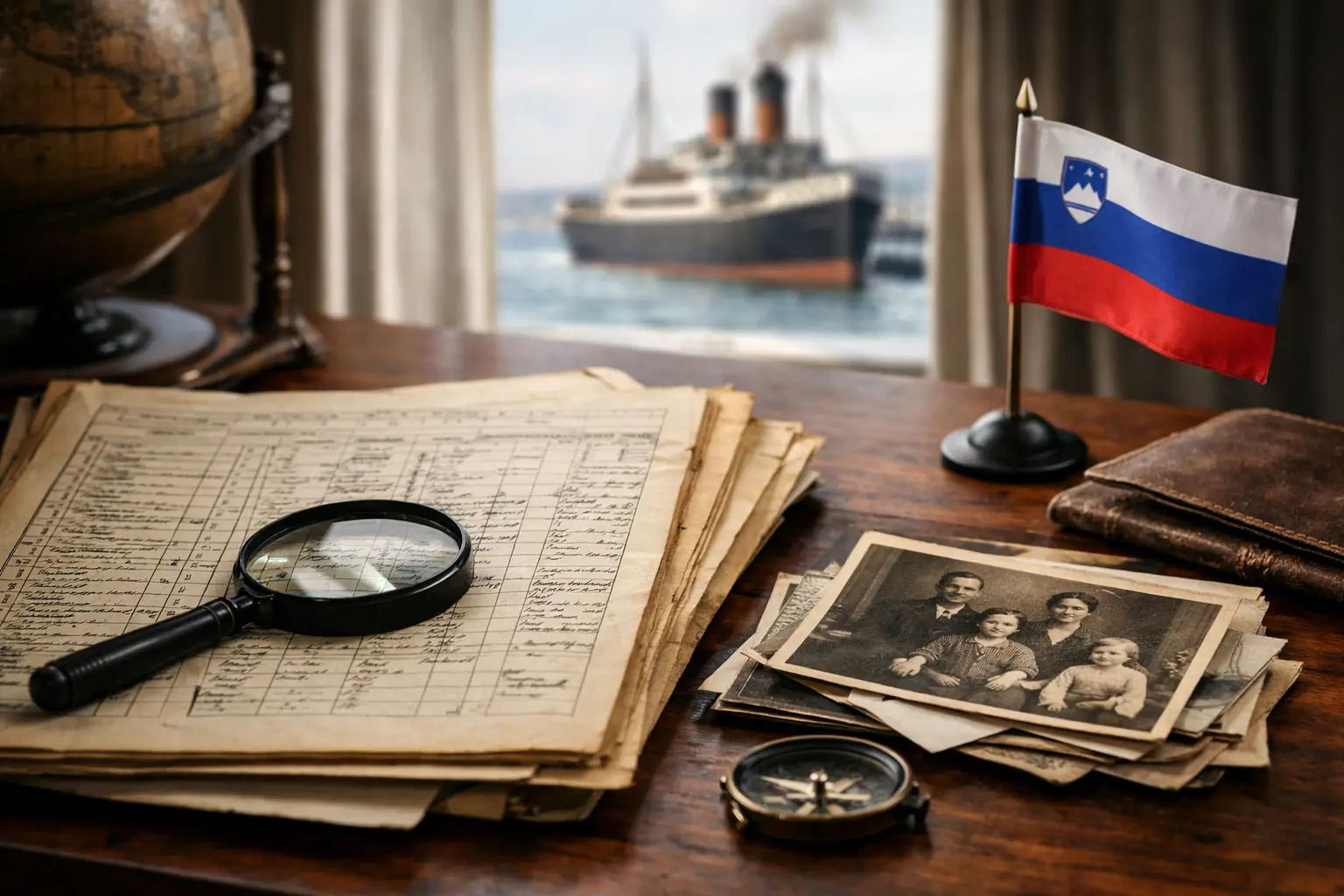
A passenger list may show the traveler’s full name, age, marital status, occupation, last residence, nationality, and destination in America. Later manifests, especially from the early 20th century, often go further. They may list the nearest relative in the old country and the name and address of the person the immigrant was joining in the United States.
That pairing is often gold for family reconstruction. If your great-grandfather was going to a cousin in Cleveland and leaving behind a mother in a village near Ljubljana, you now have two family anchors on two continents. Even when the birthplace is written phonetically or misspelled, the combination of names, ages, and migration patterns can point you in the right direction.
Sometimes the clue is indirect. A final destination in a known Slovenian American community, such as parts of Ohio, Pennsylvania, Illinois, or Minnesota, may support the idea that you have found the correct person. Witnesses, traveling companions, and neighbors on the same manifest can also matter. Slovenians often migrated through chain migration, following relatives or people from the same parish. One passenger list entry can lead to several more.
The challenge with Slovenian names and places
This is where many families get stuck, and for good reason. Slovenian surnames were often recorded by clerks who wrote what they heard. A name like Kovačič might appear as Kovacic, Kovachich, Covachich, or another variation entirely. First names also shifted. Janez might become John, Ivan might appear as Johann or John, and Marija could be Mary.
Place names can be even more complicated. An ancestor’s village may have been listed in German, Slovenian, Italian, or Hungarian form depending on the time period and the port of departure. Some places belonged to the Austro-Hungarian Empire when your family left, so the manifest may reflect an imperial geography rather than a modern national one.
This is why it helps to avoid reading a manifest too literally. The exact spelling may be wrong, but the record can still be right. Sound, region, family association, and destination all need to be weighed together. In Slovenian genealogy, certainty often comes from a cluster of matching clues rather than one perfect line on one page.
How to read a manifest with a genealogist’s eye
It is tempting to search for a name, find a likely match, and stop there. But the most helpful reading is slower and more relational.
Start with what your family already knows. Even a rough immigration year, a mining town in Pennsylvania, or the name of a brother who stayed in Europe can guide the search. Then study every column on the manifest, not just the passenger’s name. Occupation, literacy, place of last residence, and final destination can all help separate your ancestor from others with the same surname.
Pay attention to the people around them. Were they traveling with a sibling, cousin, or neighbor from the same village? Was someone from the same place already living at the destination address in America? These patterns often confirm identity when the handwriting is difficult or the spelling is inconsistent.
It also helps to compare the manifest with later records. Census entries, draft registrations, church records, tombstones, obituaries, and naturalization papers can either support the manifest or expose a mismatch. The goal is not to force one record to fit. The goal is to let the records speak to each other.
When a ship manifest gives you a village name
This is the moment many families wait for.
A village name on a manifest can open the door to parish registers of baptisms, marriages, and burials. It can lead to old cadastral maps, cemetery visits, local archives, and the church your ancestors attended. It can also change the emotional shape of your family story. Your ancestry is no longer somewhere in Slovenia. It is in a specific valley, hillside, town square, or parish where generations once lived.
Of course, a village name still needs to be verified. Some names repeat across regions. Some were recorded with outdated spellings. Some travelers named a nearby market town rather than their actual hamlet. But even an imperfect place name is often enough to begin narrowing the field.
For heritage travel, this is where research becomes deeply personal. Standing in the right village is different from simply visiting Slovenia. It turns a beautiful trip into a homecoming rooted in evidence.
When the manifest does not tell the full story
Not every passenger list delivers a clear answer. Some are sparse. Some are hard to read. Some contain mistakes. And some ancestors did not arrive in the way the family imagined.
A person may have entered through Canada and crossed the border later. They may have traveled under a different version of their name. They may have come in stages, returning once and emigrating again. Women can be especially difficult to trace if they appear under maiden names in one record and married names in another.
This is where patience matters. A missing village on the manifest does not mean the trail ends. It simply means the manifest becomes one piece of a larger reconstruction. In many cases, the breakthrough comes when a manifest is combined with church records, naturalization documents, military records, or family letters.
That is also why families often benefit from expert guidance. Slovenian research is rarely just about finding a document. It is about interpreting historical geography, language shifts, parish structure, and migration routes with care.
Turning a passenger list into a return journey
For descendants of Slovenian emigrants, a ship manifest can be more than proof of arrival. It can become the starting point for return.
Once an ancestor’s village is identified with confidence, a different kind of journey begins. You can move from ports and paperwork to churches, homesites, cemeteries, and local stories. You can understand why your family left, what they carried with them, and what still remains in the landscape today.
That is the heart of heritage travel. It is not tourism built around landmarks alone. It is travel shaped by your family’s own path. At Ancestry Slovenia, this often means helping descendants move from immigration clues to the exact places where a grandparent’s or great-grandparent’s life began.
If you are holding a passenger list, even one with hard-to-read handwriting and uncertain spellings, do not underestimate it. That page may contain the first real directions back to your family’s Slovenian home. Sometimes all it takes is one line on one manifest to turn a long-told family story into a place you can finally stand in, with your own feet on the ground.