

A family story often begins with a place name that was misheard, shortened, or forgotten. Someone remembers that great-grandfather “came from Austria,” or that a grandmother sailed from Trieste, or that a cousin thought the family name was changed at Ellis Island. This is exactly where slovenian emigration passenger lists can become meaningful. They do more than document a voyage – they can help turn a vague migration story into a real path back to an ancestral village.
For families of Slovenian descent, passenger lists are rarely the whole answer. But they are often one of the records that helps everything else fall into place. A ship manifest may point to a last residence, a nearest relative left behind, a destination in America, or the name of a traveling companion from the same area. Those details can open the door to parish registers, civil records, old house locations, and eventually a visit to the landscape your family once called home.
Why Slovenian emigration passenger lists matter
Slovenian ancestors usually did not leave from a country called Slovenia, because modern Slovenia did not yet exist as an independent state. Many emigrants departed when the region was part of the Austro-Hungarian Empire, and later the Kingdom of Yugoslavia. That historical reality is one reason families struggle to find the right records. An ancestor may be described as Austrian, Hungarian, Carniolan, Yugoslav, Italian, or Slovene depending on the year, border changes, language, and the person recording the information.
Passenger lists matter because they capture a person in motion, at a moment when old-country identity and new-world plans briefly appear on the same page. You may see a birthplace, a residence, an ethnic description, or even the name of a parent, spouse, or sibling back home. For descendants who have inherited only fragments, that can be the first truly solid bridge between family memory and archival evidence.
Still, these records have limits. Not every manifest is legible. Names were spelled phonetically. Ages shift. Places were written in German, Italian, Slovene, or older administrative forms. Sometimes the village listed is not the birthplace at all, but the last residence before departure. That does not make the record less useful. It simply means it should be read carefully and compared with other sources.
What you can learn from passenger lists
A good passenger list can tell a surprisingly human story. Beyond the obvious facts, it can show whether your ancestor traveled alone or with relatives, whether they had been in the United States before, and who paid for the journey. It can reveal whom they were going to join – often a brother, uncle, husband, or neighbor whose name may already exist somewhere in your family tree.
For Slovenian research, the most valuable detail is often the place connection. That might be a town, village, district, or older province. Even an imperfect place name can be enough to move the search forward. Once a likely place is identified, the next stage becomes much more focused. Instead of searching all of Slovenia, you can begin working with parish boundaries, cemetery records, local archives, and village histories tied to one specific area.
Passenger lists can also help explain chain migration. Many Slovenian emigrants followed relatives or people from the same village to industrial centers in the United States, especially in Ohio, Pennsylvania, Illinois, and Minnesota. If several surnames from one manifest reappear in the same American mining or steel town, that is often more than coincidence. It may reflect a community migration pattern that connects your family to a precise region in Slovenia.
Where Slovenian emigration passenger lists fit in your research
Passenger lists are best used as a middle record, not always a starting record and rarely an ending one. If you begin with only a surname and a family story, you may first need American records such as census entries, naturalization files, death certificates, obituaries, church records, or tombstones. Those can provide an estimated arrival year, a spouse’s name, or a more accurate version of the original surname.
Once you have that foundation, passenger lists become easier to identify. And once you have a likely manifest, the real work begins – interpreting what it says in historical context. A departure port like Hamburg or Le Havre does not mean your family came from Germany or France. A note saying Austria does not rule out Slovenian origin. A surname that looks Croatian or Germanized may still belong to a Slovenian family line, especially in border regions.
This is why context matters so much in Slovenian genealogy. Borders shifted. Languages overlapped. Clerks wrote what they heard. Families adapted names to survive and settle. Passenger lists are valuable not because they are perfect, but because they preserve clues from the migration moment that other records may not.
How to read a passenger list with Slovenian ancestors in mind
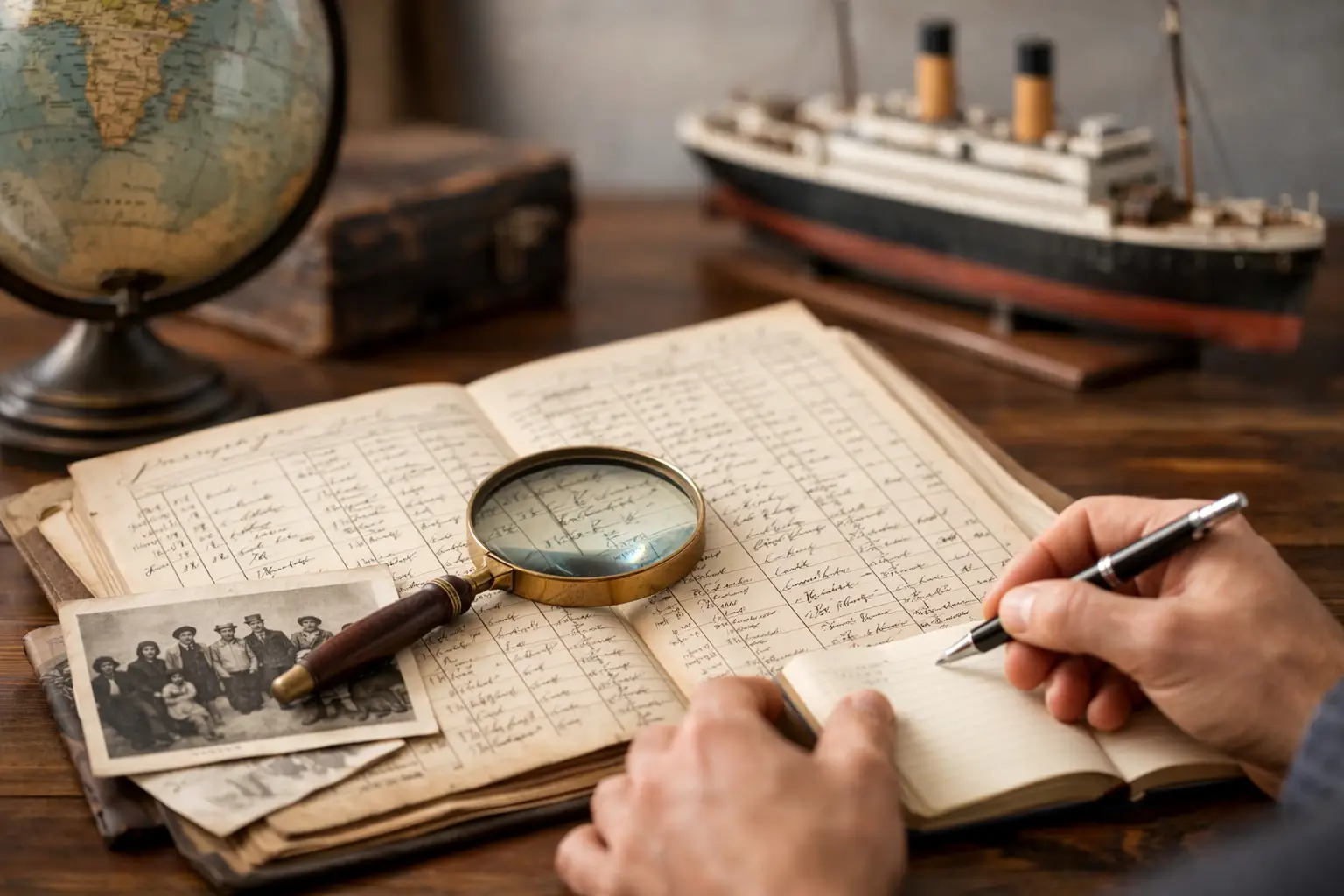
The most common mistake is focusing only on the passenger’s name. In many cases, the better clues sit in the surrounding columns. Read every line attached to that person. Look for the last permanent residence, place of birth, nearest relative in the old country, final destination, and the name and address of the person they are joining.
Then pay attention to the people listed nearby. Families often traveled in clusters, and neighbors from the same village frequently sailed together. A familiar surname on the same page may be a cousin, future in-law, or someone from the same parish. If your ancestor’s village name is badly written, another passenger from the same place may have a clearer version.
It also helps to think historically about geography. A village now in Slovenia might have been recorded under a German name, an Italian form, or an older district label. A place written as “Krain” or “Carniola” points toward central Slovenian lands. Coastal and western regions may appear in Italian forms. Northeastern areas may reflect Styrian or Hungarian administrative naming. Small differences can change the direction of your search, so interpretation matters as much as transcription.
When the record is close, but not certain
Many descendants find a passenger list that seems right but not fully proven. The age is off by two years. The destination city matches, but the surname spelling is slightly different. The nearest relative’s name is unfamiliar. This happens often, and it does not always mean the record is wrong.
Emigrants were not always precise with ages. Clerks made mistakes. People used nicknames, middle names, or local versions of names that later disappeared in America. Some migrants also gave practical answers rather than exact ones, especially if another relative had arranged work or housing. The key is to weigh the whole picture, not one detail in isolation.
This is where a careful, place-based approach can make all the difference. If the passenger list leads to a village that later matches a baptism record, a house register, or a family grave, uncertainty starts to narrow. What looked like a maybe becomes part of a documented story.
From a ship manifest to a home village
The emotional power of this work is hard to overstate. A passenger list may look like a plain administrative page, but for many families it is the first record that places an ancestor between worlds. One line on a manifest can lead to a church where they were baptized, a hillside cemetery where their parents are buried, or a village lane their family walked for generations.
That is also why research and travel belong together. Once a likely village is identified, family history changes. It stops being abstract. You can stand in the place your ancestors left, hear the church bells they knew, and understand migration not only as a fact but as a lived decision shaped by poverty, opportunity, duty, and hope.
At Ancestry Slovenia, we see this often. What begins as a search for a manifest ends as something more personal – a return to place, memory, and belonging. Passenger lists are not just transportation records. In the right hands, they are starting points for homecoming.
A patient search often brings the clearest answers
If you have been searching for your Slovenian family and the trail feels scattered, do not assume the story is lost. Passenger lists can be messy, incomplete, and sometimes frustrating, but they often hold the clue that connects everything else. One village name, one relative’s address, one traveling companion can change the direction of your research.
The goal is not only to find a ship. It is to understand the journey well enough that your ancestor becomes visible again – not just as a name on paper, but as a person who left one home and hoped to build another. That kind of discovery stays with a family for generations.