

A single remembered village name can change everything. One older relative might say, “Your great-grandfather was from near Novo Mesto,” or “We had cousins who stayed in the old country,” and suddenly a family story that felt distant begins to point to a real place. That is why the best questions for older relatives genealogy are not just about collecting facts. They help preserve memory before it disappears, and they often reveal the clues that records alone never will.
For many families with Slovenian roots, these conversations are where the journey truly begins. A baptism record may confirm a date, but an aunt or grandparent may remember the house name, the parish, the nickname everyone used, or why the family left. Those details can open doors in research and, later, make a heritage journey feel deeply personal.
Why family interviews matter so much in genealogy
Older relatives hold a different kind of archive. It is not always tidy or exact, and sometimes memory bends around time, emotion, or family silence. Still, these stories often contain the pieces that never made it into official documents.
In Slovenian family history, this matters more than many people expect. Surnames changed spelling after immigration. Village names were written in German, Italian, or older local forms. People identified themselves by a farm name, a house name, or a parish rather than the exact municipality listed on a modern map. If you only ask for names and dates, you may miss the clue that actually helps you find the right place.
That is why good genealogy interviews are less like interrogations and more like guided conversations. The goal is not to test someone’s memory. The goal is to help them remember.
The best questions for older relatives genealogy start with place
If your family came from Slovenia or neighboring regions, place is often the most valuable clue. Ask gently and ask in more than one way.
Start with simple questions such as where the family lived, what the town or village was called, and whether there was a nearby church, parish, or larger city. If they do not remember an official place name, ask what the family called it. Ask whether there was a hill, river, train stop, shrine, or market town nearby. Sometimes a remembered landmark is more useful than a formal answer.
It also helps to ask about distance and direction. Did the village feel isolated or close to a city? Did relatives walk to church, take a cart, or travel by train? These details can help narrow down a location later, especially when multiple villages share similar names.
Ask about homes, farms, and house names
In many Slovenian communities, families were known by a house name as much as by a surname. This is one of those details descendants often do not think to ask, yet it can be extremely valuable.
Ask what people called the home place, whether the family owned land, and whether the house still stands. Ask what kind of work was done there. Was it a farm, a vineyard, a workshop, or a smallholding? Even if the answer seems ordinary, it can reveal social status, migration patterns, and ties to a specific village.
Ask for names, but ask beyond the family tree
Names matter, of course, but a useful interview goes further than “Who was your father?” and “When was your mother born?” Ask about full names, middle names, confirmation names, nicknames, and alternate spellings. Ask whether anyone changed their name after coming to America or another new country.
Then widen the circle. Who were the godparents? Who lived next door? Which cousins were especially close? Which families married into yours more than once? In close-knit villages, these connections can be important. A relative may not recall a great-grandmother’s exact birth year, but they may remember that she came from “the Novak farm across the parish road.” That kind of memory can lead somewhere real.
Ask what people were called in daily life
Immigrant families often lived with two versions of identity at once. A man baptized as Franc may have become Frank. Marija may have been Mary. Some used one name at church, another at work, and a third inside the family.
Ask older relatives what names people actually used, and who used them. Ask whether Slovenian was spoken at home, whether English replaced it, and whether certain words or expressions survived. Language can carry location clues, too, especially when regional habits or pronunciations linger across generations.
The best questions for older relatives genealogy uncover migration stories
Most descendants know that someone “came from Slovenia,” but not always why, when, or through whom. This is where careful questions can bring family history to life.
Ask who left first. Was it a young man who came for work and later sent for siblings? Was it a married couple? Did someone leave to avoid military service, poverty, political pressure, or lack of land? Was the departure planned, reluctant, or sudden?
Ask what they brought, what they left behind, and whether they expected to return. Did letters come back from home? Were money and packages sent? Did anyone visit after immigration, or was the break final? The emotional shape of migration matters. It helps descendants understand not just movement, but loss, resilience, and belonging.
Ask about ports, papers, and routes
If an older relative remembers hearing about a port city, a ship name, a railroad stop, or the first American town where family settled, write it down. These fragments can help you locate passenger lists, naturalization files, church records, and chain migration patterns.
Sometimes the family story will not be perfectly accurate. That is normal. A remembered route may be slightly wrong, but still close enough to guide the next step.
Ask about religion, customs, and family rituals
For Slovenian genealogy, parish life is often central. Even families who were not deeply devout may have marked life through baptisms, marriages, feast days, and burial customs.
Ask where the family went to church, which saint’s day mattered most, and what holidays were celebrated in special ways. Ask whether there were traditions around Christmas, Easter, All Saints’ Day, weddings, or funerals. Did the family keep old recipes, prayer cards, hymn books, or religious objects? Did they mention a patron saint or a pilgrimage site?
These details do more than add color. They can help identify parish ties, regional habits, and the cultural world your ancestors carried with them.
How to ask sensitive questions without shutting people down
Not every family story is easy. There may be painful memories around poverty, war, illegitimacy, conflict, alcoholism, adoption, or estrangement. Some relatives will speak freely. Others will circle around certain topics or avoid them altogether.
It helps to ask with humility rather than urgency. Instead of pressing for an answer, try saying, “If you’re comfortable sharing, I’d love to understand what life was like then.” Give people room to say, “I don’t know,” or “I never asked.” Silence can be part of the story too.
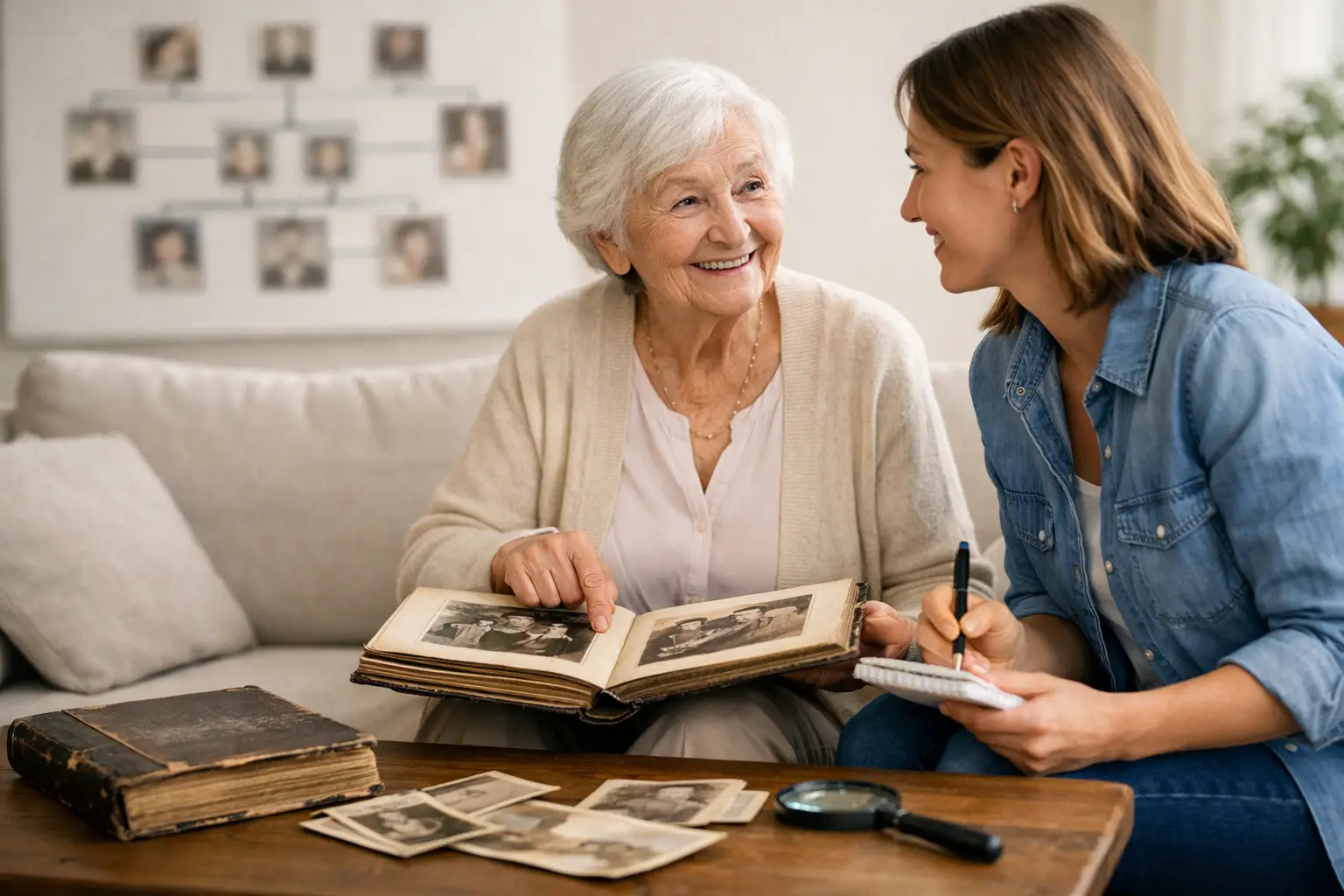
Timing matters. A long interview with a recorder on the table may feel formal and tiring. A shorter conversation over coffee, photographs, or a family meal often brings out more natural memories. Old pictures, letters, recipe cards, prayer books, and funeral cards can all prompt recollection better than direct questioning alone.
What to record during the conversation
Write down exact phrases when something sounds unusual or specific. A house name, a village nickname, an old-country pronunciation, or the name of a nearby parish can be more valuable than a polished summary later.
Record uncertainty as uncertainty. If someone says, “I think it was near Celje,” do not turn that into a firm fact. Memory is precious, but it needs context. Note who said it, when they said it, and whether anyone else remembered it differently.
If your relative agrees, audio recording can be a gift to future generations. The facts matter, but so does the voice telling them.
When family stories and records do not match
This happens often. A relative may remember the wrong year, the wrong port, or a slightly altered surname. That does not mean the conversation failed. It means you have gathered clues that need interpretation.
Family memory and archival records each tell a different part of the truth. Records may be more precise, but stories explain motive, identity, and meaning. When the two do not align perfectly, the answer is usually not choosing one over the other. It is learning how they fit together.
For descendants hoping to trace Slovenian roots, this is often where expert help becomes valuable. A remembered village fragment, church detail, or house name can be the key that connects an immigration story to the right parish and the right place on the ground. That is where a research-guided heritage journey can become something more than sightseeing. It becomes a return to the landscape your family once knew.
Ask while you still can, and ask with care. The best conversation may not give you every answer, but it can hand you something just as meaningful – the sound of your family remembering where home began.