
If your search for Slovenian ancestors has turned up a baptism in one place, a marriage in another, and a death record that seems to belong to someone else entirely, you are not alone. The question of parish records vs civil records often comes up at exactly this stage – when family stories start meeting the realities of historical recordkeeping.
For many descendants of Slovenian families abroad, these two record types are not just technical categories. They are often the bridge between a surname on paper and the village where your family once worshipped, married, buried loved ones, and built daily life. Knowing the difference can save time, prevent mistaken identities, and bring your research much closer to the place your ancestors called home.
Parish records vs civil records: what is the difference?
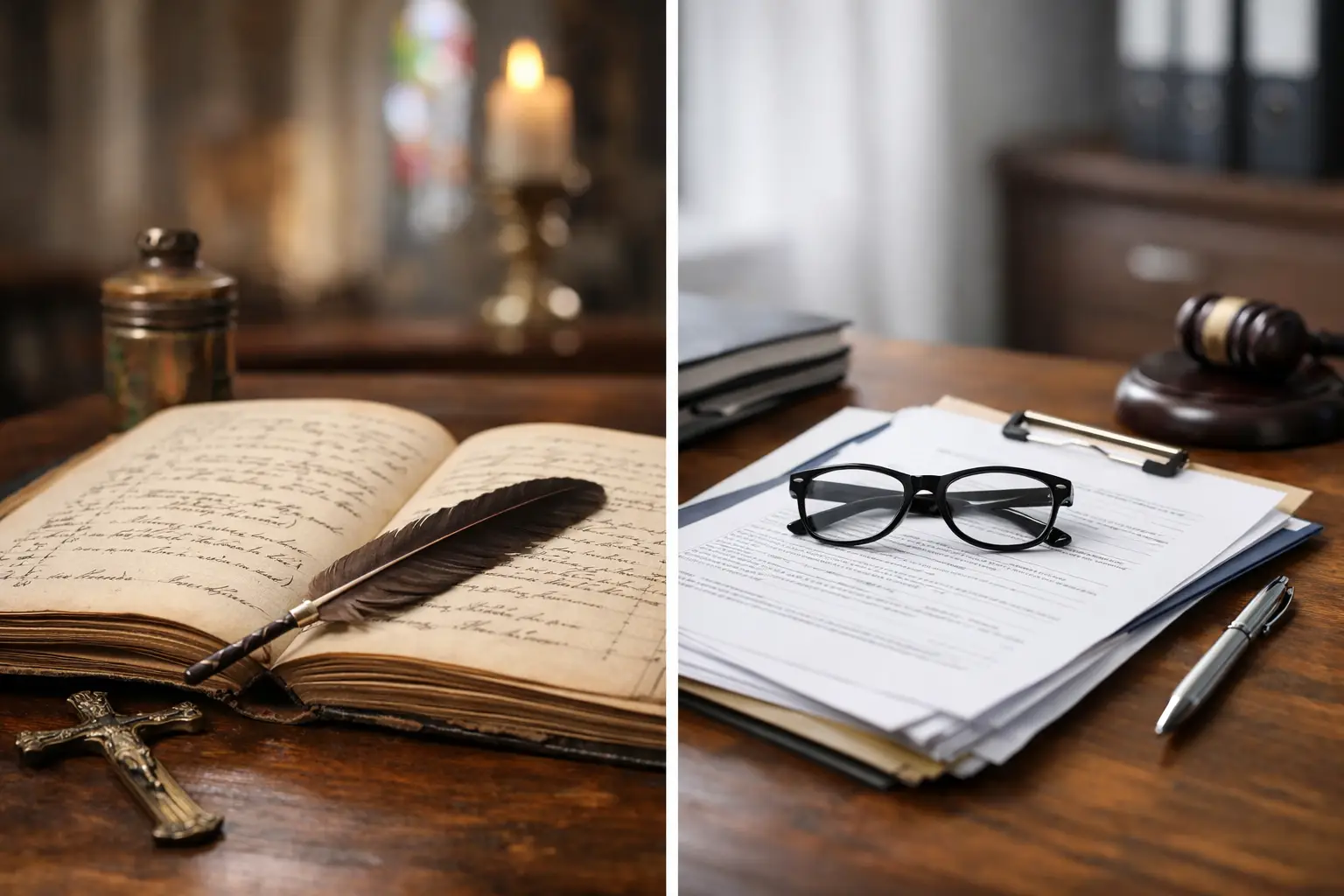
At the simplest level, parish records were created by the Church, while civil records were created by government authorities. Both can document major life events such as births, marriages, and deaths, but they were not always kept in the same periods, with the same detail, or for the same purpose.
In Slovenian genealogy, parish records often reach further back in time. Before modern state registration became standard, the local parish priest was usually the person recording baptisms, marriages, and burials. These entries were tied to religious life, but they also functioned as the main proof of family events for entire communities.
Civil records came later and were part of government administration. Depending on the period and place, they may have been kept by municipal offices, district authorities, or other state bodies. They were intended to serve legal and bureaucratic needs, which means they can sometimes be more standardized than parish entries.
That sounds straightforward, but in practice, there is overlap. Some time periods have both. Some villages relied more heavily on one system than the other. Some records were copied, translated, or reorganized under different governments. In lands that are now part of Slovenia, that matters a great deal because borders, administrations, and recordkeeping practices changed over time.
Why parish records matter so much in Slovenian family history
If your ancestors left Slovenia in the late 19th or early 20th century, parish records are often the heart of the story. They can place a family in a specific village and parish community long before immigration papers ever mention them.
A parish baptism record may include the child’s name, birth date, baptism date, parents, house number, and godparents. That last detail is easy to overlook, but it can be deeply useful. Godparents were often relatives, neighbors, or close family friends. In a small Slovenian village, those names can help confirm whether you are following the right family line.
Marriage records can be especially rich. They may identify the bride and groom, their ages, whether they were single or widowed, their fathers’ names, and the parishes they belonged to. When a family moved even a short distance, marriage entries can reveal that shift.
Burial records can also tell a quiet but important part of the family story. Infant deaths, epidemics, repeated losses in a household, and the burial of multiple generations in one parish all help us understand what life was really like. For families trying to reconnect with their roots, these records often turn history into something deeply personal.
What civil records can add
Civil records tend to become more valuable as you move forward in time. They can provide cleaner, more standardized details and may include information not found in church books. Depending on the period, a civil birth or death record might note occupations, exact addresses, reporting witnesses, legitimacy status, or administrative remarks.
For emigrant families, civil records can also help clarify identity when several people shared the same given name and surname. That was common in Slovenian villages, where naming patterns repeated across generations. A government record might distinguish between two men named Johann Novak by occupation, residence, age, or spouse.
Civil marriage records can be particularly useful when church entries are brief or when a couple married in a location different from their home parish. In some cases, civil registration also continued through periods of political change with more consistency than local parish access.
Still, civil records are not automatically better. Sometimes they are less personal, less detailed about family networks, or simply not available for the years you need.
When parish records are stronger than civil records
There are many Slovenian research cases where parish records are the better source. This is especially true for earlier generations, rural villages, and periods before full civil registration was firmly in place.
Parish books were often maintained continuously over long spans of time. That continuity matters when you are tracing one family through baptisms, marriages, and burials in the same community. You can often watch a household form, grow, lose members, and connect with neighboring families across decades.
Parish records may also preserve Latin, German, or older local naming forms that can help place a family in a very specific historical setting. While that can make the records harder to read, it can also make them more revealing. The handwriting, the house number, the recurring sponsors, and the priest’s notes all carry context that a later typed civil extract may leave out.
For descendants trying to identify an ancestral village, parish records are often the breakthrough source because they are tied so closely to local community life.
When civil records are the better path
There are times when civil records deserve your attention first. If you are researching more recent generations, need legal proof of a birth or marriage, or want to verify exact dates from a government source, civil registration may be the more practical choice.
Civil records can also help when church records are missing, damaged, difficult to access, or recorded under a parish you would not think to search. In some situations, state-created documents are easier to navigate because they follow a consistent format.
They can be useful for women in particular, since maiden names, marital status, and changes in household structure may be recorded in ways that are easier to follow. They may also help track people who moved into towns, crossed administrative lines, or lived through wartime disruption.
This is why parish records vs civil records is rarely an either-or question. The best results usually come from reading both together.
The real challenge: records do not always agree
One of the hardest moments in genealogy is finding two records that should match but do not. A birth year shifts. A surname changes spelling. A father’s name appears in one entry but not another. A village name is written in German in one record and Slovene in the next.
That does not always mean one record is wrong and the other is right. It may mean the information was reported by different people, recorded years apart, or shaped by the language and administration of the time. In Slovenian research, this is common enough that disagreement between records should be treated as a clue, not a dead end.
A parish priest might have known the family personally and recorded local relationships with confidence. A civil clerk may have written what was reported by a neighbor or relative under stressful circumstances. In another case, the reverse may be true. Context matters.
This is where careful comparison becomes so valuable. Looking at names, house numbers, witnesses, occupations, and surrounding families often reveals whether two records belong to the same person.
How to use both record types together
The most effective family history research rarely depends on a single document. It builds a case from several records that support one another.
If you begin with a civil death record from an immigrant ancestor abroad, that may give you an approximate birth date and parents’ names. A parish baptism record in Slovenia can then confirm the child, identify the village, and connect that person to siblings. A marriage entry may show the next generation back. Burial records may reveal grandparents in the same house line.
This layered approach is often what turns uncertainty into confidence. It also turns research into something more meaningful than data collection. Once a family is tied to a specific parish and village, the landscape changes. The church is no longer just a line in a register. It becomes a place you can stand in. The cemetery is no longer abstract. It becomes part of your family’s map.
That is why this work matters so much to heritage travelers. At Ancestry Slovenia, we often see that the emotional turning point comes when documents stop feeling distant and start pointing to real ground, real communities, and real belonging.
What this means for your search
If you are early in your journey, do not worry about choosing the perfect record set from the start. Begin with the clues you have. Family names, approximate dates, religion, migration timing, and even old family memories about a patron saint or village church can all help determine whether parish or civil records are more likely to lead first.
If you are further along and facing conflicting information, that is not a sign of failure. It usually means you have reached the point where deeper local context is needed. In Slovenian genealogy, the answer is often not in one record, but in the conversation between records.
The most meaningful discoveries often come slowly. A baptism entry, a marriage witness, a burial note, a house number repeated across decades – these are the details that bring a family home again, one document at a time.